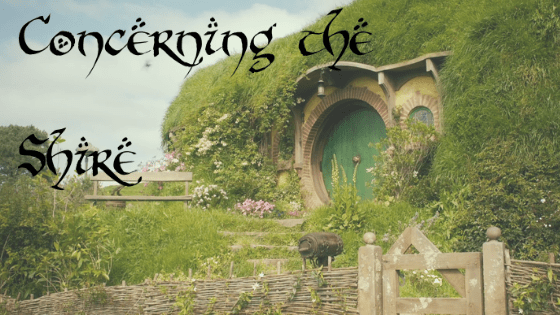
I can’t tell you how many times I’ve read The Lord of the Rings series, or watched the movies, extended editions only, of course. The world of Middle Earth has a way of drawing me in, and I love any minute I can spend there (Sometimes I even watch the movies with commentary from the actors, I know, super nerdy of me, but would totally recommend). While there are so many conversations to be had and themes to explore within the series, one question for me comes to mind every time I enter into the world: Why hobbits from the Shire? Why are halflings, unnoticed by so many, the beginning, center, and end of this epic tale?
Warning: spoilers ahead for all of Lord of the Rings. To be fair, you’ve had about 65 years to read the books and 20 years to watch the movies.
If you’ve watched the Lord of the Rings, specifically the last of the trilogy The Return of the King, you know that there are about a dozen endings. (At least, it feels that way when you’ve sat through a 12-hour marathon and need to get to the credits for a bathroom break.) Once the eagles rescue Frodo and Sam from the fires of a collapsing Mount Doom, then the Fellowship has to be reunited at Rivendell, Aragon has to be crowned king, the Fellowship parts again as the hobbits head back to the Shire, they enjoy a pint together, and Sam gets married. STILL not the end: Frodo decides to take the last boat leaving the Grey Havens with Gandalf, Bilbo, and the elves, and THEN Sam finally comes home to his family. Only after all of that does the “Into the West” song play and the names role.
But there’s one ending that Peter Jackson for whatever reason decided not to include in the movie: a chapter in the book titled “The Scouring of the Shire.” In this chapter, the four hobbits come back to the home they’ve fought for, the home they’ve longed to see since leaving more than a year ago, but it is much changed. Gandalf has already separated from them to see Tom Bombadil (a character also notably absent from the film), saying that it is time for the hobbits to fight again for their own home, that this is what they’ve trained for. On coming to the Shire, they find themselves blocked by a gate, a barrier that has never been a part of Shire-life. Unsurprisingly, they easily overtake the hobbits guarding the gate, who keep mentioning “the Chief” living at Bag End, and our beloved heroes make their way to Bag End to take on the Chief and liberate the Shire from his rule. However, the Chief is not Lotho Baggins as they assumed, but Saruman, disguised as Sharkey! It turns out he and Wormtongue escaped from Orthanc tower using his last weapon, his voice, and took control of the last free part of Middle Earth. It is up to the four hobbits to rid the Shire of this bully and free all hobbits from his power-hungry influence.
I’ve never liked this part of the book. By the time they finally get back to the Shire, I am reveling from the last epic battle at the Black Gate and wiping away tears at the “Many Partings” of dear friends, and this fight for the Shire seems… tacked on? Slightly ridiculous to picture hobbits, who are farmers, picking up their pitchforks at the sound of Merry’s horn? Wouldn’t it have been more suitable and fitting to end with the hero’s commendation given to the hobbits, and a goodbye at the Grey Havens?
But maybe that is really the point of the whole story. The biggest, most evil enemy of the time is defeated by the choices of the smallest, most unassuming creature. One small phial of starlight is enough to overcome the shadow of darkness that lays over the land. The little things, the overlooked things, matter. This little corner of peaceful life consumed only with hearty food, full pints, and a good smoke is worth protecting. As exciting as it is to fight in the grand battles, walk with the noble elves, and feast in the halls of kings, I think Tolkien always meant to point us back to the goodness of simplicity, exemplified by the Shire-folk. Hobbits are small in stature, but not in honor. Notice too that the best of hobbits are not small-minded; all four of our heroes answered the call to adventure when it came knocking at their door and bravely played their part in a larger narrative. In the same way, the Shire and the centrality of the hobbits teaches us to tend our corner of the earth, but to also be ready to fight for the light and play a role in the bigger world beyond our little home when the time comes.
I think I’m also sad to see the Shire corrupted. Hobbits never harm each other, and yet here in this scouring, hobbits kill each other. Saruman has already destroys much of Fangorn, and now the trees of the Shire are all cut down for his industry. I suppose it breaks my heart to see this scene through the eyes of the hobbits. Throughout the whole story, the Shire is a haven. I fell in love with the Shire from the very beginning of “Concerning Hobbits,” and my love for it only grows the farther the hobbits get from it. Merry and Pippin talk often of their home, telling stories of the simple life of the Shire to kings, elves, and the Ents, most of whom have never even heard of hobbits or their home. Even in the darkest parts of Mordor when Sam is at his weariest, the thought of summertime in the Shire gives him the strength to carry on. It was meant to be a preserved garden, always fruitful and always safe from the arm of the enemy now that the Ring has been destroyed, and yet, it too became corrupted and twisted to the evil will of the enemy.
Of course, the story ends on a hopeful note for the Shire, , as Saruman is finally defeated and fades away into nothingness. The hobbits help rebuild the Shire, starting with Sam planting a new tree from the soil of Lothlorien. The Shire becomes safe for future generations, but those who fought for it don’t get to see a full restoration. Their sacrifice isn’t truly rewarded, especially for Frodo. And so we understand why Frodo, still feeling the ache of his wound and the weight of the ring, leaves Middle Earth.
“I tried to save the Shire, and it has been saved, but not for me. It must be so, Sam, when things are in danger: some one has to give them up, lose them, so that others may keep them.”
Frodo, “The Grey Havens”
Even the best of endings come with sorrow, wounds that leave scars, memories too painful to dwell on. We mourn what we lost along the way, but we are better for the journey and stronger for the fight. And that is why hobbits.
There is so much more to be said on the subject, but as I do not possess Tolkien’s gift of making worlds with only words, I’ll let him finish out my thoughts with Bilbo’s poem:
The Road goes ever on and on
Out from the door where it began.
Now far ahead the Road has gone,
Let others follow it who can!
Let them a journey new begin,
But I at last with weary feet
Will turn towards the lighted inn,
My evening-rest and sleep to meet.
 Hopeful Wanderer