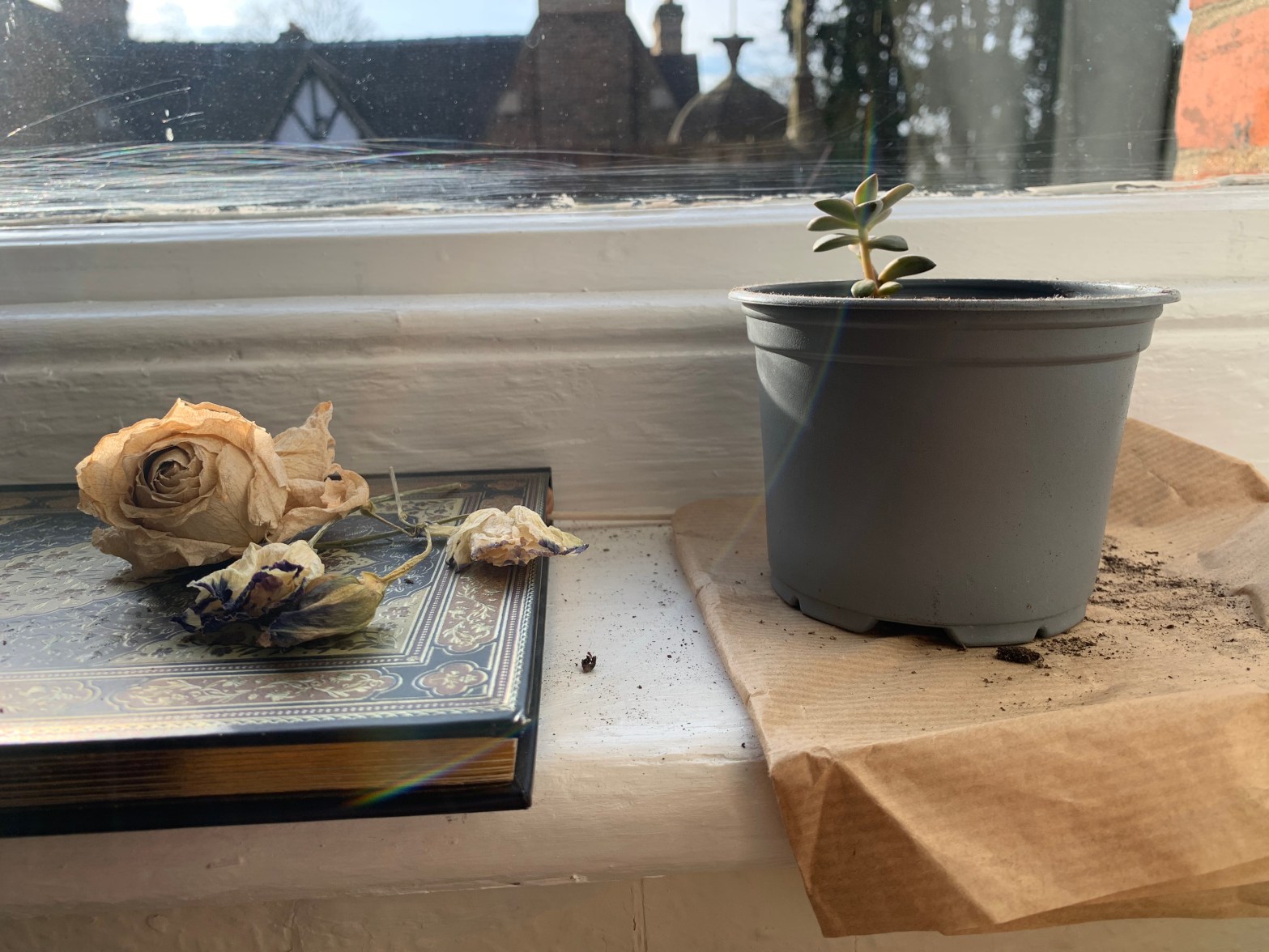
Fun fact: I’m writing this while sitting on my desk (not at, on), which is the best way to get as much sun on my face as possible. Vitamin D is a hot commodity in the UK, especially in lockdown. Speaking of lockdown…
I’m very fed up with lockdown. Most days, I’m fine with it, I really am. Wearing a mask is no different than wearing a jacket, and I don’t often think about how long its been since I sat down in a restaurant. I go about my work and I meet with people for walks whenever I think I might go crazy from sitting at my desk. It’s better to ignore the question of when will it end and just accept that this is how things are. Every now and then, though, I lift up my head and look around, or the faintest memory of a semblance of “normal life” breaks through the clouds. I’m faced with a choice in those moments: do I push it back with distraction, or do I lean into it? And if I do lean into it, do I stop when I feel frustration and self-pity, or do I dig deeper and attend to what’s really happening?
I bring this up now because I just finished reading John Mark Comer’s Ruthless Elimination of Hurry, and wow did this book impact me. If you haven’t read it, I can’t recommend it enough. I had heard about it almost a year ago and actively avoided picking it up. I liked my busy life, and I’ve always thrived with a full schedule. I wasn’t ready to be convicted about how I chose to fill my time and the mindset of productivity with which I live my life. After all, look at everything I’ve accomplished and achieved! That doesn’t come from a slow, contemplative life! (or does it…) Whether or not I was ready to let go of my busy life, its gone. And in reading this book, for the first time I realised how thankful I am. Because as much as I don’t have, what I do have is space.
I think thankfulness for the space is the first step to living a life of rest, the kind of rest that Augustine is talking about when he says, “Our hearts are restless until they rest in you” (Confessions). Or the type of rest defined in Hebrews 4. If I’m not thankful for the space, then silence and solitude becomes oppressive, and distraction is my only way to cope. This is not to say that distraction, which for me in lockdown is usually good food, decent TV, and writing papers, is always a bad thing. Even Tolkien advocated for a certain type of “escapism,” comparing fairy stories to a prisoner thinking of something other than his prison walls and jailers. However, when I’ve gotten to the point where I play music or have TV on in the background ALL the time because I literally can’t handle the silence and my thoughts that fill it, that’s maybe a sign that I have a problem. My heart is too restless.
What was I afraid to find in the space? Myself, not enough
I don’t want to over-spiritualize self-care; sometimes self-care really is just enjoying an extra brownie guilt free, or stepping away from my laptop with its harsh blue light to go for a walk. There comes a point, though, when I’ve done all the self-care things, and its not enough. My resources and my soul have been exhausted by my own attempts to rest. And just like every other time that I come to the end of my rope, I have to turn back to God and say, it really is just you that I need, isn’t it? Laughing a little bit, he opens his arms and says, took you long enough. Just kidding, he’s actually much kinder than that. Romans 8:1 says no condemnation, remember?
Of course I want lockdown to end, for so many reasons. I’m an extrovert whose top love languages are touch and quality time, and God made me that way for a very beautiful reason. This is more space than I ever would have asked for, but I’ve decided I don’t want to miss what he’s doing right now. In this quiet space, by myself, the Spirit moves. Together, God and I are unhurried, and some day when the space fills up again with things, I will be ready with a heart resting in God and a deeper capacity for grace.
I’m still figuring out what the spiritual discipline of rest and simplicity looks like for me; in fact, I’m about to embark on a 7,000 word essay trying to answer that question. I do know that rest comes when I stop trying so hard to rest (you would have thought that would be obvious but apparently not). The beauty of it is that it will probably be a life-long journey of hopeful wandering, and it will take many shapes and forms with the changing seasons. Thankfully, God is unchanging, and his presence is always there, and its always what I need more than anything else.
Seriously, read The Ruthless Elimination of Hurry, and be ready to pay attention.
 Hopeful Wanderer