I’ve just finished Kazuo Ishiguro’s most recent book, Klara and the Sun. This was my first Ishiguro book, and I can’t wait to read more. There is so much I could say about this book because it asks so many questions. I’m not sure I understood all of it, so I’ll avoid the more confusing parts for now, but I can safely say it is a beautiful book that offers a beautiful answer to the oft-asked question: what does it mean to be human? I will try not to spoil too much of it, but I believe Ishiguro’s answer is that we are defined by the ones who love us.
The basic premise of the book is that it takes place in a not-so-distant future, and it is narrated by an Artificial Friend named Klara. Klara spends the first part of the book waiting in the shop for the right human to come buy her, and the rest learning how to be the best AF she can be to Josie, whom Klara chooses as much as Josie chooses Klara. Though Klara tells the story, I would argue Josie is the main character, since the plot and all of the other character’s motivations revolve around Josie, and her needs and desires. I surprised myself with this observation, since I also found Josie to be the most uninteresting character. She is only a teenage girl, who happens to be able to draw well, preparing to go to college. Her mother, Chrissie, her neighbor Ricky, and Klara are all much more complex, and change throughout the story. But Josie is Josie because she is loved by them, and most of the novel is the characters doing what they can to make Josie happy.
The question of love and humanness is of course made more complex by the fact that Klara is an AI. She is created literally for the purpose of being a friend to someone else, and in this world, people can compare and buy AFs based on the latest, most desirable features. It exposes a corruptness of love: when we love something, we sometimes deceive ourselves into thinking we can and should possess it. Very soon, love looks more like control, and the fear of loss blinds us. Chrissie’s mom is a case in point (really avoiding spoilers here, read the book for more explanation on what she is afraid to lose and the lengths she almost goes to in order to avoid losing it). But what a difference from “you choose who you are” to “you are who loves you.” In a time when we are so caught up by what or who we can love, what might it look like to instead let ourselves be defined by those who love us? And how does that change our relationships, knowing that how we love others has a part to play in their personhood? No one, not even an robot in a store window, is an island.
Can Josie truly love Klara? Maybe, but she will always be a possession, a toy left behind when it is time to grow up (I got serious Toy Story 3 vibes at the end of the book). Can Klara love Josie, if she lacks this human ability to be loved as a person? Based on the conclusion of the book, I think Ishiguro would say no, but Klara does offer an interesting example to follow as we learn to love. Her distinguishing feature is that she observes the world. She loves to watch and learn, so that she can understand what it is to be human, so that she can serve her person better. We might balk against the subservient attitude she always takes, uncomfortable with her lack of agency since her sole purpose is to exist for someone else not to feel lonely. Even so, what might we learn from this unassuming, gentle character? How might we sit in the shop window, as it were, to watch the world go by and look for those human moments, like the reunion of the Coffee Cup Lady and Raincoat Man? I am inspired by how Klara is able to see signals that communicate, so much more than words can, what someone desires and needs. She sees, and therefore knows, people better than they know themselves because of her ability and desire to watch. I wonder when my own desires have gotten in the way of what someone is trying to communicate, and how I can learn to pay attention better, for the simple purpose of loving better. And in our loving others, they become more themselves.
“Mr Capaldi believed there was nothing special inside Josie that couldn’t be continued…But I believe he was searching in the wrong place. There was something very special, but it wasn’t inside Josie. It was inside those who loved her.”
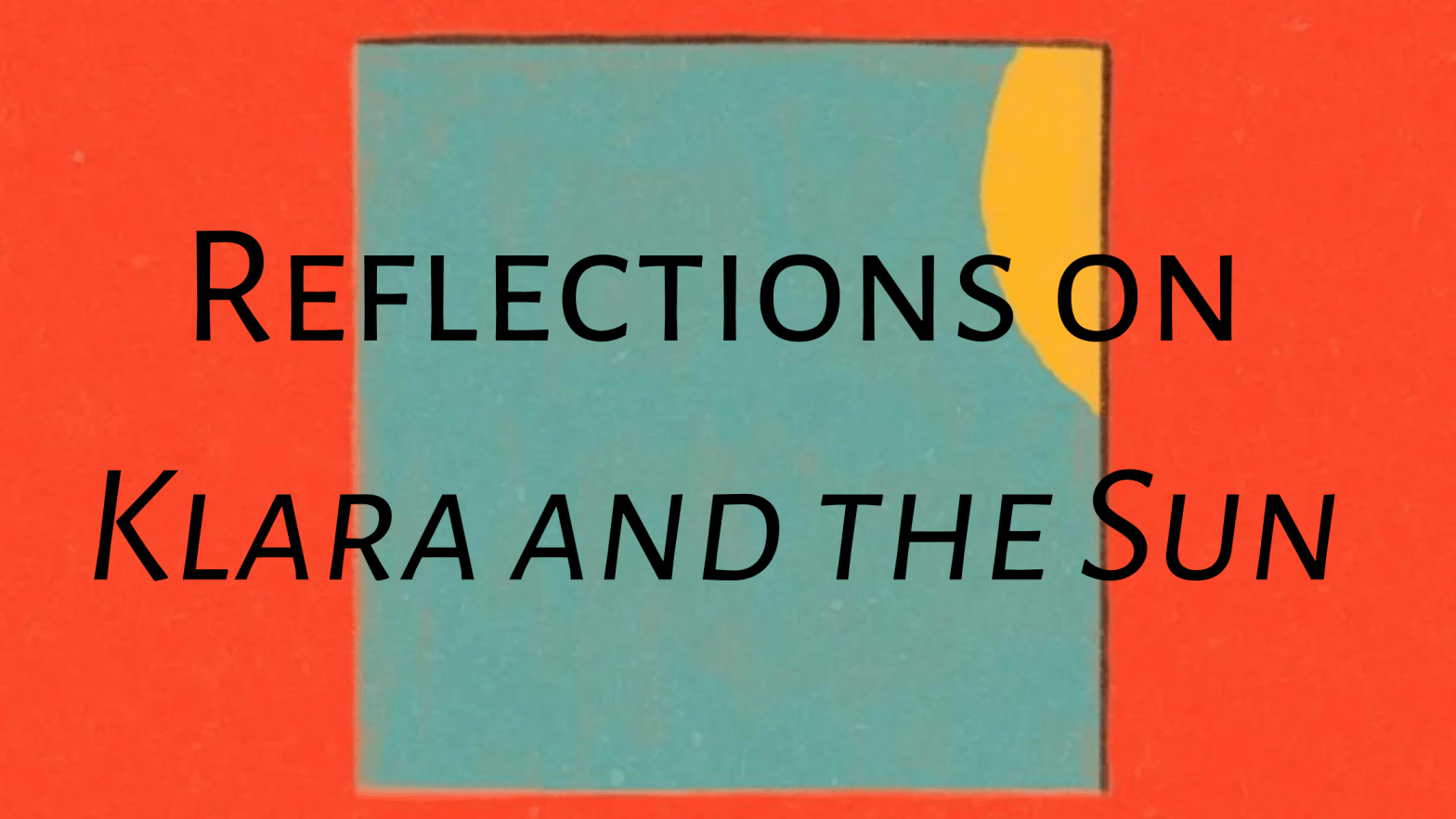
Another important character I have yet to mention: the Sun. I’m still mulling over the Sun’s role in the story. Functionally, it seems like Klara is solar-powered, so she feels a special affinity to the Sun. She also attributes every good thing that happens to the Sun’s blessing, and acts of her own accord to help the Sun shine more on people. The Sun is a providential, magnanimous presence in the story; it is kingly and personable, but also mysterious and distant at times, just out of reach. The minimalist cover of the book is a window to a blue sky, with less than half of the golden disc of the sun peeking around. This silent, benevolent character shines from nearly every page. I can feel Klara’s worshipful love for the Sun, especially now that I live in a country where sunshine is a scarce commodity. Winters can truly be dark here, when the sun sets as early as 3pm, but the late evening sun is the greatest gift of England’s summer. Ishiguro himself grew up in Surrey, so I’m sure he understands the desperation I sometimes feel for even the slightest ray of warm sunshine during the darkest, cloudiest winter days.
I might have only picked up on this influence because I happen to also be reading Michael Ward’s Planet Narnia and CS Lewis’ Voyage of the Dawn Treader. Ward argues that Lewis in writing The Chronicles of Narnia wove in a cosmology of the seven heavens, so that each book takes on a “donegality” of a different planetary influence. VotDT‘s planet is Sol, the Sun. The book is heavy in gold imagery, and the characters are traveling eastward, literally treading the dawn of Aslan’s Country. Sol is also characterized by kingly generosity, exerting a transfiguring air on those who bask in its light. The adventurers on the ‘Dawn Treader’ enjoy the same kind of refreshment and rejuvenation from the Sun that Klara loves and wishes for her people. What light refreshes and sustains us? How might we be inspired by the nature of Sol to bring things out into the light for illumination?
I’ll end with a little prose I wrote after spending a morning reading in the sun. Reading it over again, I was startled and pleasantly surprised by how much it resonates with Ishiguro’s themes, though I had not even heard of Klara and the Sun before writing this:
Have you ever noticed the smell of a person who has soaked in the sun? It’s not the smell of salty sweat from the body cooling itself down, although I’m sure what I’m thinking of includes that. It’s the scent that only arises when the skin is laid bare before the light of the sun, layers shed because there is no more need for clothes and heavy blankets to keep warm. The air, the grass, the world itself is warm, when we and it and they live under the gaze of the sun. It is the smell of a body purified by the rays of an all-seeing sun that gave of itself of a morning and asked us to give only ourselves. And in the giving of ourselves we were given our self so we saw the light and understood. We understood how it loves, and its peace, and its knowledge of us.
 Hopeful Wanderer