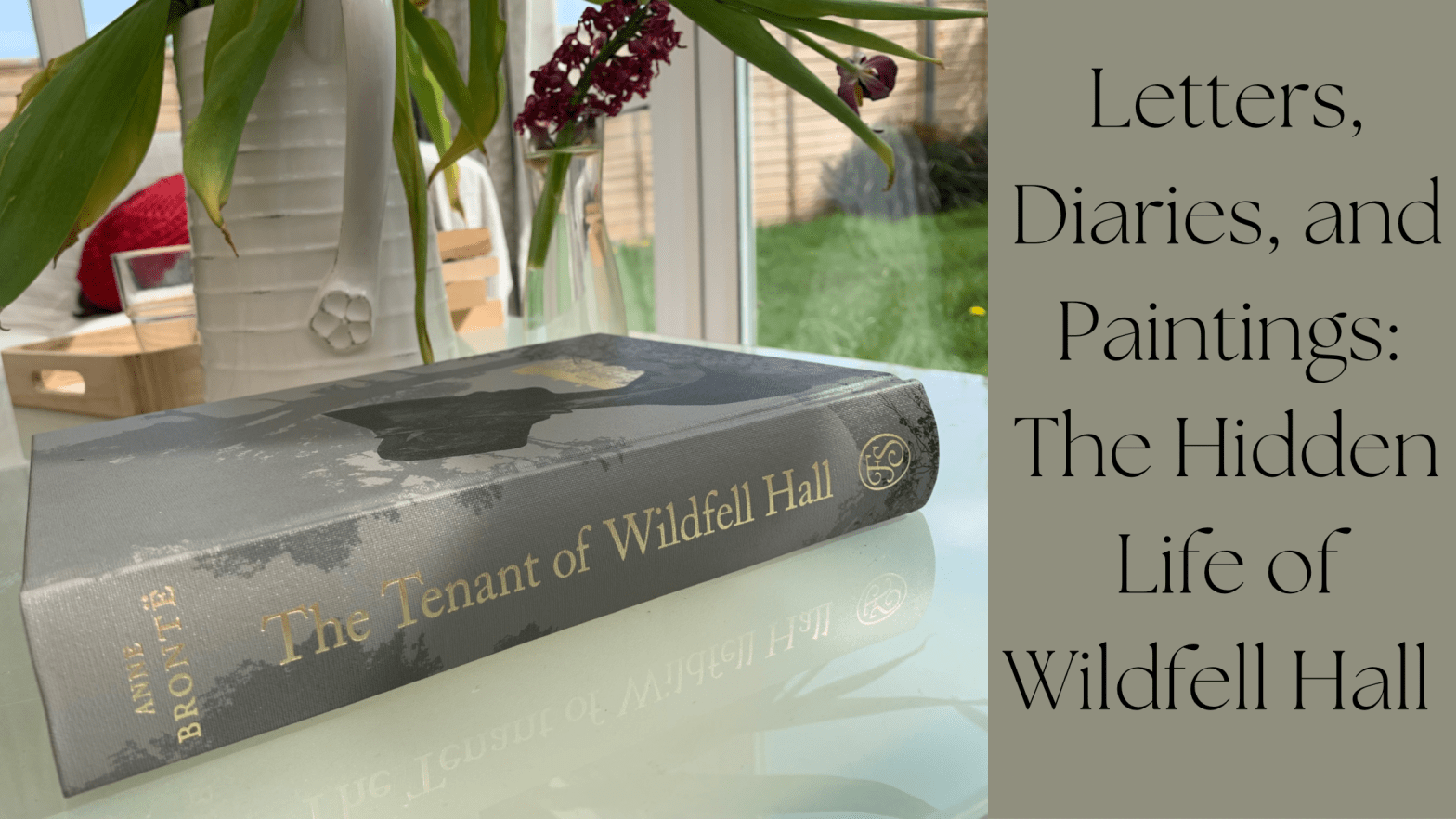
This winter, I took a literary trip back to the wild, windy moors of Yorkshire, not with the stoically independent Jane Eyre and her steadfast author Charlotte, nor with the strangely mesmerizing drama of Cathy and Heathcliffe and their more romantic author Emily, but with the quiet unassuming yet inspiring Helen Huntington and her forgotten author Anne. Now, with spring properly woken up, I’m collecting my thoughts and musings on this, in my opinion, under-appreciated novel.
The Tenant of Wildfell Hall is the second novel of Anne Brontë, published just under a year before her early death of tuberculosis. Anne, like the rest of the 6 Brontë children, lived under the shadow of death and decay. Their mother died shortly after Anne’s birth, and only Charlotte lived past the age of 31. The 3 novelists watched their brother Bramwell waste away his promise in drink, drugs, and affairs. Yet despite this grief that hung over them (or perhaps because of it), Charlotte, Emily, and Anne, managed to produce some of the greatest novels of the 19th century, and arguably, some of the most influential feminist novels of all time.
In my very limited research into their lives, specifically Anne’s, I found there is a huge amount of scholarship and criticism surrounding them. Scholars have debated endlessly on how autobiographical their novels are meant to be, and long speculation about Charlotte’s influence on her sisters’ literary reputations after their deaths. Charlotte and Emily definitely take the stage often in scholarship, and Anne is often left in the wings. As one biographer of hers said, she is only noted for her unnotability. Her reputation suffers from being part of a family that produced two other successful authors, as she and her work will always be compared to that of her sisters. Poor pious Anne. And yet, this morally upstanding sister managed to imagine and write a story with incredible scandal: in-depth depictions of a man succumbing to alcoholism, a woman escaping an abusive marriage, unfiltered allusions to an affair. What does this say about Anne? Was she truly prophetic of her brother’s demise? Does her lack of notability discredit her heroine’s feminist power?
I don’t know enough about the Brontë’s, Victorian England, or literary criticism to comment on those questions. I’m only a reader interested in exploring a few themes and asking more questions of a book that I enjoyed.
Letters and diaries both reveal and conceal the true self.
All of TWH is either a letter or a diary. The novel begins with the hero Gilbert Markham (not much of a hero though in my opinion, he’s a dull and simple character who’s motivated mostly by infatuation) writing a letter to explain how he came to marry a woman named Helen. The recipient of the letter makes no other appearance in the novel, so the writer of the introduction in my copy questions the necessity of such a frame. Markham’s commentary is not well-informed and blind to much of human nature. However, once I got to part 2, which is the account of Helen’s ill-fated marriage told through her diary given to Markham, I was immediately drawn into the first-person restrospect that understands itself as it is written. Helen shifts in the reader’s estimation from the mysterious, aloof woman described in Markham’s letters to a profoundly kind and loyal feeler and thinker.
The fact that she shares her story through a diary, rather than a conversation with Markham, gives us a unique and intimate view of her inner life. She is unfiltered and open, truly seen and heard for probably the first time in her life. Markham does not get to interrupt with his judgement, opinion, or questions, until he finishes reading the diary and comes back to her. Yes, one could consider her a wholly unreliable narrator as she would naturally self-edit as she goes along, any person with a limited perspective does so, but I do think she is brutally honest with herself. She questions the wisdom of her accepting Huntingdon’s proposal, even before things take a turn as he shows his true colors. We get to see her working out as she goes along what her duty as a wife and mother is in an increasingly worsening situation.
Her diary contains what power she has in the political game of Victorian marriage. She hides her true self in its pages.
Her true self remains hidden even to some who read her diary. At one point, the unfaithful husband Huntingdon finds and reads Helen’s diary, and he is dismissive, calling it vulgar and womanly (in the sense of the word that means overly emotional, opposed to a manly reason and clarity). Though he is given window into Helen’s inner life through her own words, he still does not see her. If he did, perhaps he would have been inspired to reform himself for her sake, and for the sake of their son. Instead, in reading her diary, he breaks into her private inner life and usurps what little power she does have.
Markham, on the other hand, reads the diary, freely given to him, and falls even more in love with her, vowing to defend and protect this woman who had no one up until now. Personally, I don’t think I would let a potential love interest read my journals; there’s a lot of Sara in there that doesn’t need to be read by anyone else. I think it does take courage for Helen to become this vulnerable. She puts herself in Markham’s power. He could read the diary and react in the dismissive manor Huntington did, or expose her to the rest of the neighborhood as an immoral woman. But she trusts him, and he proves himself faithful and trustworthy (I guess Anne thinks infatuation can go a long way for a man).
So Helen keeps her diary secret from the world, but she does reveal herself through her unworded creations: her paintings, which she sells to support her and her son. This art, also dismissed by Huntingdon as frivolous and cherished by Markham, is Helen’s ticket to independence. Her impressions of the world around her, though disguised for protection with false place names and sold as from an anonymous artist, reveal her eye for beauty in the landscape and halls of her new home.
Maybe Anne felt similarly courageous only through her writing. She did have to brave much critique against her character, so much so that Charlotte felt the need to publish another edition, one highly edited to preserve the estimation of Anne. Many questioned how she was able to write a story that depicted such a terrible situation, for only the imagination of someone warped and corrupted could produce a story like this. There is also the moral question of Helen’s leaving her husband, though she graciously comes back to nurse him at the end of his miserable life. I imagine it takes a great deal of love to care for someone who is dying, and adding the layers of grief that the someone has caused much pain and is dying because he was consumed with addiction. Maybe Charlotte edited the novel because it was too prophetic of Bramwell’s death, her grief too much to be made public. We can’t depend on the story too much to give us an insight into Anne’s inner life, but I think it is safe to say Helen is the outworking of Anne’s hope that moral uprightness can flourish without arrogance, and that love grows when one trusts enough to share the secret self.
 Hopeful Wanderer