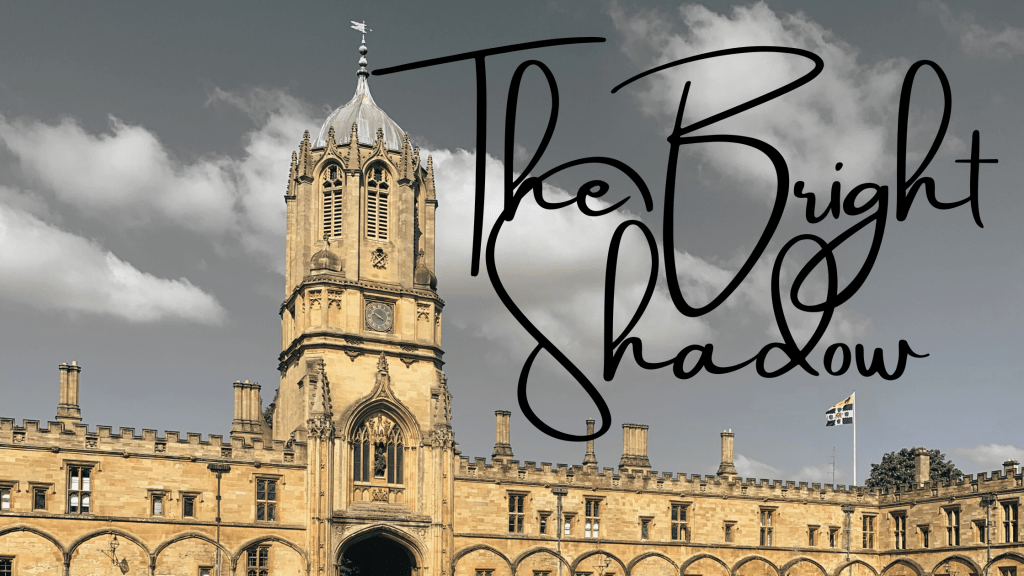
I had the privilege of sharing some of my thoughts on the importance and power of storytelling at a small conference of children, family, and youth workers this week. I mostly said yes just for the lunch in the Christ Church college dining hall (the famous inspiration for the Hogwarts dining hall), but also I’ll take any excuse to talk about why I love fairytales and fantasy. The conference was called “The Wow, the Why, and the How of Storytelling” and included practice on writing stories and Godly play, and a tour of the cathedral through the eyes of a medieval pilgrim. My short talk was very well-received, to my pleasant surprise (hard to remember your ideas are cool when you’ve spent so much time with them), so I thought I would share it here. It’s basically pieces of the storytelling sections of my dissertation, so nothing new, but it’s a good summary of the really fun part and leaves out the less universally appealing methodology and philosophy.
I grew up immersed in books and stories. I know the transformational power of books, especially fantasy, because I was transformed by the experience of entering another world through reading. Although asking me to pick my favorite book is an impossible question to answer, I can confidently say none captured me as fully, or made me long so deeply for the feeling of something else as The Chronicles of Narnia and The Lord of the Rings. These stories of the fantastic and magical “baptised my imagination,” to use Lewis’s words, and invited me to enter a world suspended in time, returning me to my reality with fresh vision and wonder. I know now that what I experienced was a taste for the radiance of transcendental Beauty, the communication of God’s infinite Glory, and at the end of my journey, I found that I saw Beauty in other experiences in my familiar world.
I believe stories, specifically fairytales and fantasy, have the power to transform our imaginations by their invitation into another world. If we have the courage to say yes to the dangerous business of going outside of our doors, despite not knowing where our feet might be swept off to, we might discover the re-enchantment of Beautiful Life. And we might discover the Beautiful Life lies not so far away after all.
We feel the cadence and rhythm of a narrative arc through its plot and particular setting. Literature’s poesis, its subcreative power, makes new characters, worlds, and cultures that reveal a new vision for our own self, world, and culture, and we are indirectly formed by its invitation to inhabit the world of the story, or empathise with a character. This especially applies to stories with settings very different to our own, and characters very unlike ourselves. The greater the distance, the more need for empathy. In engaging with literature, we see both ourselves in the reflection of the window, and the world to which the window opens. Lewis writes, “in reading great literature I become a thousand men and yet remain myself. Like the night sky in the Greek poem, I see with a myriad eyes, but it is still I who see. Here, as in worship, in love, in moral action, and in knowing, I transcend myself; and am never more myself than when I do.” (Experiment in Criticism, 141) When we read, we are exposed to the transcendent experience of another world with its stories and people, yet paradoxically we discover more of ourselves through the experience.
Imagination and the Christ Myth
Imagination is the light by which we see what is already there, though we had not seen it before. The Christian faith claims that what is already there, the possible within the actual, is the life of the kingdom revealed by the embodied parable of Jesus. He is the root-metaphor for the kingdom, and the form of Beauty. The incarnation means our apprehension of God is not only abstract; Christ made Beauty’s communication personal by becoming a person himself, giving us concrete forma so that we apprehend God in the incarnation and create beauty from our delight in him. In his incarnation, death, and resurrection, the theodrama of Christ’s movement, what Lewis and Tolkien called the Christ Myth, revealed the pattern of the Beautiful Life.
Tolkien found this pattern in the eucatastrophe of fairytales. ‘Eucatastrophe’ is Tolkien’s word for the Consolation of a happy ending in fairytales, while ‘Dycatastrophe’ is his word for sorrow and failure. According to Tolkien, from dycatastrophe comes eucatastrophe: defeat is not the final word in either fairytales or the story of our lives. Victory comes in a “sudden joyous ‘turn.’” Applied to spiritual formation, this guides us in understanding God’s presence as eucatastrophic movement in our lives as we imagine the world as it could be, beautifully sung according to the shape of his kingdom, which we know because of Christ’s communication of Beauty. We tell construct a narrative theology, which means we looks backwards to find meaning out of past experiences and uses the imagination to look forwards, envisioning how we might embody the Beautiful Life. Applied to youth ministry, we are guiding youth in the vital task of identity formation through the stories of their lives that answer the questions: “Who am I? Do I matter? And How do I relate to others?” We help them find the sudden joyous turn through the communication of Beauty.
But why fairytales?
Tolkien argues that the best fairy-stories are “plainly not primarily concerned with possibility, but with desirability. If they awakened desire, satisfying it while often whetting it unbearably, they succeeded.” We feel the rhythm of a well-told story, so that the head knowledge of Truth makes its way to the heart by way of beauty, and vice versa. Fairytales communicate beauty especially through their strange otherworldliness that still has enough echoes of familiarity. Our desire for Beauty is awakened when they include the 4 elements of Fantasy, Recovery, Escapism, and Consolation. (“On Fairy Stories” 10) Fantasy is Tolkien’s reappropriation of Imagination and fancy conceived as a virtue. (OFS 10) In fairy-stories, fantasy has an “arresting strangeness,” yet it is familiar enough because it is made from the real Truth and Beauty we already know. (OFS 48) Fantasy provides Recovery, or a regained health and vision that sees things not as they are, but “‘as we are (or were) meant to see them’ – as things apart from ourselves.” (OFS 58) This newfound vision sees how the luminous things of Faërie are luminous, or glorified in the familiar world, what Lewis called in his autobiography ‘a bright shadow’ (see Surprised by Joy) coming out of the story and resting on his vision of his world.
Lewis only experienced this because of Escapism, which Tolkien defends saying, “Why should a man be scorned, if, finding himself in prison, he tries to get out and go home?…The world outside has not become less real because the prisoner cannot see it.” (OFS 60) We need Escapism to imagine the kingdom of God and to hope in the Consolation of the Happy Ending, the last and most important gift of fairy-stories. In the happy ending, “when the sudden ‘turn’ comes we get a piercing glimpse of joy, and heart’s desire, that for a moment passes outside of the frame, rends indeed the very web of the story, and lets a gleam come through.” (OFS 70) Our stories do not have an end while we live them, and though we may fear the unknown of potential tragedy, Christian imagination consoles us with hope in the happy ending, beyond the story known in the present. Tolkien also writes that the happy ending “does not deny the existence of dycatastrophe, of sorrow and failure: the possibility of these is necessary to the joy of deliverance; it denies (in the face of much evidence, if you will) universal final defeat and in so far is evangelium, giving a fleeting glimpse of Joy, Joy beyond the walls of the world, poignant as grief.” (OFS) If the Gospel is a fairy-story, the escape from death is only through death, and the consolation of the happy ending we long for comes in the new state of Creation.
Tolkien’s essay defending fairy stories concludes with the astonishing fact that the gospel, the evangelium, is the greatest fairy-story told, with the greatest eucatastrophe erupting from the greatest dycatastrophe. The story pauses on the cross, beholding it for a breathless moment, but it does not stop there. The resurrection, and its invitation for us to follow Christ into death and life again, casts the cross in a new light, a bright shadow. This is the Christ Myth, and it bleeds into all the best stories. Redemption, reconciliation, restoration, new life, surprising joy, perseverance, hope in the midst of despair, faith in the darkness, love that conquers: all these tell God’s story.
The Christ Myth
The Christ Myth echoes in our own lives when we sub-create by telling our own stories in the light of eucatastrophe’s hope. If faith is a journey, struggles and hardships are only the middle of the story, and though these moments of tragedy are indeed difficult, the drama of the Christ Myth means that Christ is both present in the suffering and promises future consolation. In the theodrama of the incarnation, suffering is not forgotten after Consolation, but remade into Beauty through the love of Christ. The stories that we tell of our lives are Christ’s, including our suffering, pain, and trials, and any beauty found in our stories is the Beauty he has written in.
We need not wait until the final happy ending to see and live this Beautiful life, however. In the midst of tragedy, we are comforted both by the future hope of Consolation and by Christ’s present identification with our suffering. By the patterns of the Christ Myth, our escape from death is through death with Christ, so that “All tales may come true; and yet, at the last, redeemed, they may be as like and as unlike the forms that we give them as Man, finally redeemed, will be like and unlike the fallen that we know.” (OFS 73)
I ended the talk with a reading from The Return of the King, but here was the culminating quote of the passage, from when Sam and Frodo have escaped from Cirith Ungol and are about to cross the plains of Mordor and climb Mount Doom:
“Far above the Ethel Duáth in the West the night-sky was still dim and pale. There, peeping among the cloud-wrack above a dark tor high up in the mountains, Sam saw a white star twinkle for a while. The beauty of it smote his heart, as he looked up out of a forsaken land, and hope returned to him. For like a shaft, clear and cold, the thought pierced him that in the end the Shadow was only a small and passing thing: there was light and high beauty for ever beyond its reach… He crawled back into the brambles and laid himself by Frodo’s side, and putting away all fear he cast himself into a deep untroubled sleep.”
 Hopeful Wanderer
Sara, thank you for this beautiful and profound piece of writing that has also been a baptism of the imagination.
LikeLike