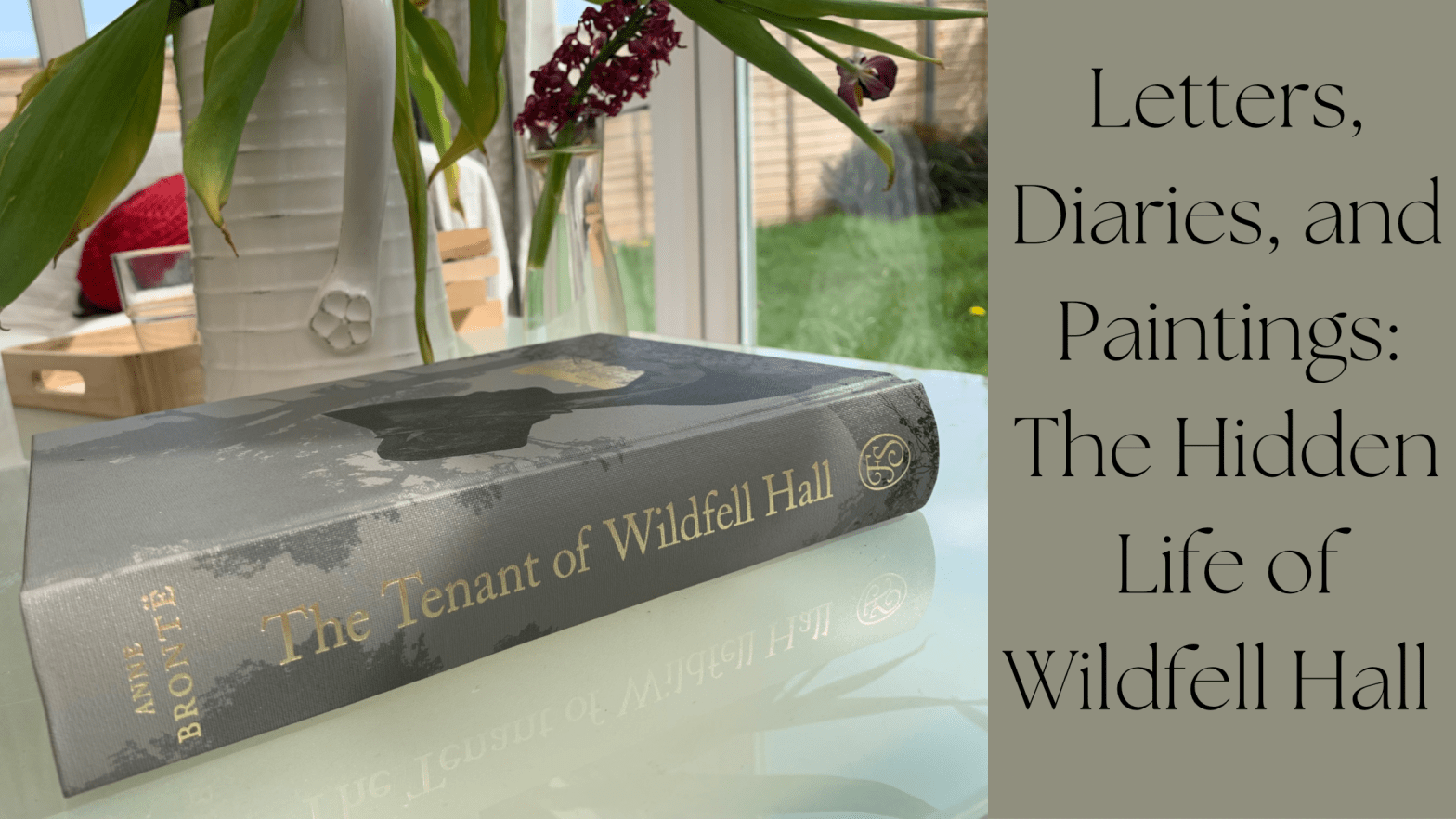
Letters, Diaries, and Paintings: The Hidden Life of Wildfell Hall

This winter, I took a literary trip back to the wild, windy moors of Yorkshire, not with the stoically independent Jane Eyre and her steadfast author Charlotte, nor with the strangely mesmerizing drama of Cathy and Heathcliffe and their more romantic author Emily, but with the quiet unassuming yet inspiring Helen Huntington and her forgotten author Anne. Now, with spring properly woken up, I’m collecting my thoughts and musings on this, in my opinion, under-appreciated novel.

The Tenant of Wildfell Hall is the second novel of Anne Brontë, published just under a year before her early death of tuberculosis. Anne, like the rest of the 6 Brontë children, lived under the shadow of death and decay. Their mother died shortly after Anne’s birth, and only Charlotte lived past the age of 31. The 3 novelists watched their brother Bramwell waste away his promise in drink, drugs, and affairs. Yet despite this grief that hung over them (or perhaps because of it), Charlotte, Emily, and Anne, managed to produce some of the greatest novels of the 19th century, and arguably, some of the most influential feminist novels of all time.

In my very limited research into their lives, specifically Anne’s, I found there is a huge amount of scholarship and criticism surrounding them. Scholars have debated endlessly on how autobiographical their novels are meant to be, and long speculation about Charlotte’s influence on her sisters’ literary reputations after their deaths. Charlotte and Emily definitely take the stage often in scholarship, and Anne is often left in the wings. As one biographer of hers said, she is only noted for her unnotability. Her reputation suffers from being part of a family that produced two other successful authors, as she and her work will always be compared to that of her sisters. Poor pious Anne. And yet, this morally upstanding sister managed to imagine and write a story with incredible scandal: in-depth depictions of a man succumbing to alcoholism, a woman escaping an abusive marriage, unfiltered allusions to an affair. What does this say about Anne? Was she truly prophetic of her brother’s demise? Does her lack of notability discredit her heroine’s feminist power?

I don’t know enough about the Brontë’s, Victorian England, or literary criticism to comment on those questions. I’m only a reader interested in exploring a few themes and asking more questions of a book that I enjoyed.


Letters and diaries both reveal and conceal the true self.

All of TWH is either a letter or a diary. The novel begins with the hero Gilbert Markham (not much of a hero though in my opinion, he’s a dull and simple character who’s motivated mostly by infatuation) writing a letter to explain how he came to marry a woman named Helen. The recipient of the letter makes no other appearance in the novel, so the writer of the introduction in my copy questions the necessity of such a frame. Markham’s commentary is not well-informed and blind to much of human nature. However, once I got to part 2, which is the account of Helen’s ill-fated marriage told through her diary given to Markham, I was immediately drawn into the first-person restrospect that understands itself as it is written. Helen shifts in the reader’s estimation from the mysterious, aloof woman described in Markham’s letters to a profoundly kind and loyal feeler and thinker.

The fact that she shares her story through a diary, rather than a conversation with Markham, gives us a unique and intimate view of her inner life. She is unfiltered and open, truly seen and heard for probably the first time in her life. Markham does not get to interrupt with his judgement, opinion, or questions, until he finishes reading the diary and comes back to her. Yes, one could consider her a wholly unreliable narrator as she would naturally self-edit as she goes along, any person with a limited perspective does so, but I do think she is brutally honest with herself. She questions the wisdom of her accepting Huntingdon’s proposal, even before things take a turn as he shows his true colors. We get to see her working out as she goes along what her duty as a wife and mother is in an increasingly worsening situation.

Her diary contains what power she has in the political game of Victorian marriage. She hides her true self in its pages.

Her true self remains hidden even to some who read her diary. At one point, the unfaithful husband Huntingdon finds and reads Helen’s diary, and he is dismissive, calling it vulgar and womanly (in the sense of the word that means overly emotional, opposed to a manly reason and clarity). Though he is given window into Helen’s inner life through her own words, he still does not see her. If he did, perhaps he would have been inspired to reform himself for her sake, and for the sake of their son. Instead, in reading her diary, he breaks into her private inner life and usurps what little power she does have.

Markham, on the other hand, reads the diary, freely given to him, and falls even more in love with her, vowing to defend and protect this woman who had no one up until now. Personally, I don’t think I would let a potential love interest read my journals; there’s a lot of Sara in there that doesn’t need to be read by anyone else. I think it does take courage for Helen to become this vulnerable. She puts herself in Markham’s power. He could read the diary and react in the dismissive manor Huntington did, or expose her to the rest of the neighborhood as an immoral woman. But she trusts him, and he proves himself faithful and trustworthy (I guess Anne thinks infatuation can go a long way for a man).

So Helen keeps her diary secret from the world, but she does reveal herself through her unworded creations: her paintings, which she sells to support her and her son. This art, also dismissed by Huntingdon as frivolous and cherished by Markham, is Helen’s ticket to independence. Her impressions of the world around her, though disguised for protection with false place names and sold as from an anonymous artist, reveal her eye for beauty in the landscape and halls of her new home.

Maybe Anne felt similarly courageous only through her writing. She did have to brave much critique against her character, so much so that Charlotte felt the need to publish another edition, one highly edited to preserve the estimation of Anne. Many questioned how she was able to write a story that depicted such a terrible situation, for only the imagination of someone warped and corrupted could produce a story like this. There is also the moral question of Helen’s leaving her husband, though she graciously comes back to nurse him at the end of his miserable life. I imagine it takes a great deal of love to care for someone who is dying, and adding the layers of grief that the someone has caused much pain and is dying because he was consumed with addiction. Maybe Charlotte edited the novel because it was too prophetic of Bramwell’s death, her grief too much to be made public. We can’t depend on the story too much to give us an insight into Anne’s inner life, but I think it is safe to say Helen is the outworking of Anne’s hope that moral uprightness can flourish without arrogance, and that love grows when one trusts enough to share the secret self.

Dust Creating

A poem for Ash Wednesday

The story began with breath,
into earth,
formed by the potter’s hand.
And despite any self proclaimed worth,
Always ends disintegrating
into no man’s land.

The margins of our lives are
Perpetually haunted by fate,
The inescapable spectre
that lies in wait.

Yet somehow I am convinced by
my vanity of vanities
that I can hold onto
my kingdom of cemeteries
Arguing against this fistful of dust
on behalf of these

Misguided directions
And misplaced affections

For what are these,
enfleshed animated fingers,
That count the years and days and hours
of a life that lingers,
Somewhere between budding flowers,
And the cosmic starry singers?

If not the measure
Of my only momentary treasure?

Once more the bell tolls
And I can barely bear this truth
That dust alone will bear witness to my stolen youth.

So why then do the mourners dance?
Why do we tell the story again and again
As if there was a chance,
I could pick up my pen
To make something beautiful out of this expanse?

Because we’ve seen the final page telling how
the last enemy
Is defeated.
by this cross upon your brow
The story is completed.

I wrote this poem to be performed at an Ash Wednesday service. There is a longer version that I wrote first but decided it wouldn’t deliver as well to the audience, but it was fun to write anyway.

Here is the original:

This story is a tragedy
Are you ready?

It’s a study in the great hamartia
The plague of the human condition
Our singular flaw
Catapulting us to perdition
And sentencing us to living inertia

Does this day perhaps belong to Saturn,
A moment to break our jovial pattern?

What began with breath into earth
Formed by the potter’s hand
Gets reclaimed by the womb that gave birth
Disintegrating into no man’s land
Unheeded by self-proclaimed worth

We are perpetually haunted by our fate
The inescapable spectre that lies in wait

Yet my vanity of vanities
Convinces me that I can hold onto
My kingdom of cemeteries
Arguing with this fistful of dirt I’ll succumb to
Exhausting my voice pleading on behalf of these

Misguided directions
And misplaced affections

For what are these fingers
That count the minutes and the hours
And the years and the life that lingers
Somewhere between the budding flowers
And the cosmic starry singers

If not the measure
Of my only treasure

Poor yorrick, the prince laments
Betrayed by his own body and bound
In this unfortunate turn of events
Where the cries in the dark resound
Only as long as the smoke from burning incense

Dust the only symbol of my stolen youth
And I almost can’t bear this truth

So why then do the mourners dance?
Why do we tell the story again and again
As if there was a chance
I could lift up my pen
To make something beautiful out of this expanse

Because the last enemy will be defeated
The story by this cross upon your brow completed

Why we need good children’s stories

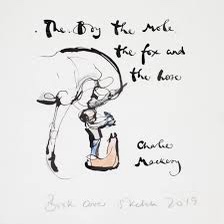
Hot take: This is not a good book

“a children’s story which is enjoyed only by children is a bad children’s story.” (‘Sometimes Fairy Stories May Say Best What’s To Be Said)

I strongly agree with Lewis on this account, as I love to read and soak in good children’s books, and I agree with him that the medium of children and fairy stories tell us something that no other medium can communicate. We’re not talking about childish books, but of books written for children that spark my imagination and show me something of the world in a way that also appeals to children. So when I found this book half price at Blackwell’s, this book that I have seen all over Instagram and heard people raving over, I thought I should give it a go.

I should first say, I’m sorry if this book has been very meaningful for you in some way, and I hope I don’t ruin your enjoyment of it or the goods to be gained. I get the appeal, I really do. It makes for some great Instagram posts because each page is a lovely illustration paired with a nice quote about friendship, love, home, or other things that make us feel nice. The simplicity of the drawings and the story make it so that anyone could relate to feeling lost and being on this journey, hoping to find friends along the way, and the messages are all about being kind to yourself, embracing imperfection, and enjoying cake.

But I’m actually not sorry to critique it, because that is all it is: Instagram posts. I assumed there would be a story between the quotes, some struggles where the boy and the animals had to learn to love each other or be brave, but there isn’t. The preface describes the boy as lonely and lost, and it seems like he journeys home with the animals, but I only figured that out because they started spouting quotes about home near the end of the book. Their friendship simply happens by proximity, with nothing earned. The only nod to the cost of friendship happens when the boy and the mole come upon the fox, who is trapped. The fox says he would have eaten the mole if he wasn’t trapped, and the mole says the fox will die if he stays in the trap, so the mole chews the fox free. But there was no struggle leading to a moment of decision to do the right thing, no questioning or growth of the mole as a character. 

I won’t deny that the characters come to some sweet conclusions, but wouldn’t we have learned more if we actually journeyed with the characters? Wouldn’t we have grown alongside them? I think especially of the horse, when he says “Tears fall for a reason and they are your strength not your weakness.” Then when the boy asks him, “What is the bravest thing you’ve ever said?” He replies, “Help.” I understand the desire to teach children they don’t always need to take up a sword to be brave and that we all need each other, but where is the horse getting this wisdom from? What struggles did he have to go through to realize that? Or did he just hear that from a mindfulness guide and waited until someone randomly asked him about bravery to sound deep and philosophical? I don’t trust the horse in this instance because I don’t know the horse, or any of the others. I want to, but there is no substance to any of them. Hilariously, the boy also asks, “So you know all about me?” The horse answers yes, so the boy asks further, “And you still love me?” “We love you all the more.” I’m really glad the boy and the animals know all about each other, that is true friendship, but I as the reader would also like to be friends with these characters, but I can’t do that because I know nothing about them.

Lewis also wrote, describing how and why to write good children’s stories, “The story itself should force its moral upon you. You find out what the moral is by writing the story.” (‘Unreal Estates’) There is no real moral to this story because the author did not bother to write a real story. 

The appeal of the un-described characters and missing backgrounds is that anyone could relate to them. Anyone could relate to being lost, wanting friends, journeying home, longing for love and acceptance, so theoretically, anyone could relate to the boy or the animals. But reading good books with good characters teaches empathy because we have to enter into the world of someone perhaps very different than us, with very different experiences, and yet we get to be surprised by how much this experience of empathy illuminates our own selves and world. One of the blurbs on the back of the copy I bought reads, “The world that I am required to inhabit is this one. But the world that I love to inhabit is the one that Charlie Mackesy has created.” I can see how it would be nice to live in a world where nothing needs to be earned, and the storm of wind and grey clouds is over in a few pages. But if we’re dreaming of inhabiting other worlds, I would rather find one that has the quality of feeling actually lived-in, instead of this world of pencil sketches.

I guess what I’m trying to say is that this book is missing what it needs to be a story: character and plot. That’s it, the bare minimum. It doesn’t even need a setting, although that adds to its weight. But without character and plot, it is merely a collection of napkin scribblings with a few trite words as captions. It frustrates me because books like this pretend to satisfy our deep longing for story and meaning, but it offers no substance. It spoon-feeds us its content, and its not even very good content. Reading this book is as easy as cotton candy (or candy floss for my UK friends), but it also lasts just as long – dissolved in a moment. Good books need to be eaten as a meal, carefully prepared, tasted and savored, and ultimately leave us satisfied yet paradoxically with a longing to spend more time in their world. It takes more time, more work, and it might require us to put aside ourselves for a moment, but what a beautiful and satisfying ending it gives.

I could say more about the value of stories and other worlds (I wrote about 20,000 words actually, gave a few presentations on it), but I’ll pause the rant. For now, here’s some children’s books I think are more worth our time:

  • The Little Prince (also a boy trying to get home, and befriends a fox, beautifully simplistic illustrations)
  • The Redwall Series (talking animals banding together to fight evil, eat LOTS of cake and good food)
  • Wind in the Willows (a mole and a mouse adventuring on a raft down the river, more cake is eaten, hilarity ensues)
  • The Chronicles of Narnia (obviously)
  • The Curdie Books (George MacDonald’s best fairytales)

Just to name a few. Any other suggestions?

Fear Not

I love reading and writing Advent poetry because Advent is itself poetry. It’s both looking back and looking forward, celebrating and mourning, waiting even as we know the wait is over. The King has come but we long for the King to come. Creation groans in eager expectation. The sacred divine dwells in ordinary human space. The one who spoke the world into existence by a word learned to speak as a baby. The one who holds creation in his hands grasps his mother’s finger with his tiny hand. The true light, knowing he would be unrecognized, rejected, and hated, came to save his own. Only poetry can hold such tension in this liminal space.

So here is the poem I’ve composed for Advent this year. I won’t say much about it, except glance over the classic Christmas story passages in Scripture (Matthew 1-2 and Luke 1-2) and note how many times the people are told, ‘do not be afraid’ or ‘fear not.’ Clearly, God was telling us something…

Fear not

A command I fear I cannot follow
Two words meant to negate this paralysis
that leaves me frozen
To calm the frantic beating of a heart hurried by panic

Fear strangely transforms vision,
It blinds, it tunnels my sight
And the match I strike to light my stump of a candle
Sputters out, leaving me in the darkness
Or it distorts and twists, so that I see only the reflections of a warped mirror
And I have to hide because it is too much
For my little unbelieving soul

But then
he told me
Everything I ever did
With such love in his eyes
And kindness in his voice
As he said my name
My name
It turned my head and then my heart
To the gardener
And the truth of it all swept me from my hiding place
Bursting through
In a chorus of stars come down from their lofts
Fear forgotten in the waters of living life

See with a new kind of fear
This little soul magnifies the Lord
As it was in the beginning
For the handmaiden who bowed her head
and said
let it be to me
and Held
that Word with fear and pondering
Close to her heart

Then the song is over, the last echoing notes
Bouncing around the chapel
A solitary figure kneels at the altar
Cold reassuring stone beneath
High vaulted ceiling above beckoning
Prayers heavenward
Evensong gives way to the dayspring
dawning eternally on the horizon

Reflections on Klara and the Sun

I’ve just finished Kazuo Ishiguro’s most recent book, Klara and the Sun. This was my first Ishiguro book, and I can’t wait to read more. There is so much I could say about this book because it asks so many questions. I’m not sure I understood all of it, so I’ll avoid the more confusing parts for now, but I can safely say it is a beautiful book that offers a beautiful answer to the oft-asked question: what does it mean to be human? I will try not to spoil too much of it, but I believe Ishiguro’s answer is that we are defined by the ones who love us.


The basic premise of the book is that it takes place in a not-so-distant future, and it is narrated by an Artificial Friend named Klara. Klara spends the first part of the book waiting in the shop for the right human to come buy her, and the rest learning how to be the best AF she can be to Josie, whom Klara chooses as much as Josie chooses Klara. Though Klara tells the story, I would argue Josie is the main character, since the plot and all of the other character’s motivations revolve around Josie, and her needs and desires. I surprised myself with this observation, since I also found Josie to be the most uninteresting character. She is only a teenage girl, who happens to be able to draw well, preparing to go to college. Her mother, Chrissie, her neighbor Ricky, and Klara are all much more complex, and change throughout the story. But Josie is Josie because she is loved by them, and most of the novel is the characters doing what they can to make Josie happy.

The question of love and humanness is of course made more complex by the fact that Klara is an AI. She is created literally for the purpose of being a friend to someone else, and in this world, people can compare and buy AFs based on the latest, most desirable features. It exposes a corruptness of love: when we love something, we sometimes deceive ourselves into thinking we can and should possess it. Very soon, love looks more like control, and the fear of loss blinds us. Chrissie’s mom is a case in point (really avoiding spoilers here, read the book for more explanation on what she is afraid to lose and the lengths she almost goes to in order to avoid losing it). But what a difference from “you choose who you are” to “you are who loves you.” In a time when we are so caught up by what or who we can love, what might it look like to instead let ourselves be defined by those who love us? And how does that change our relationships, knowing that how we love others has a part to play in their personhood? No one, not even an robot in a store window, is an island.

Can Josie truly love Klara? Maybe, but she will always be a possession, a toy left behind when it is time to grow up (I got serious Toy Story 3 vibes at the end of the book). Can Klara love Josie, if she lacks this human ability to be loved as a person? Based on the conclusion of the book, I think Ishiguro would say no, but Klara does offer an interesting example to follow as we learn to love. Her distinguishing feature is that she observes the world. She loves to watch and learn, so that she can understand what it is to be human, so that she can serve her person better. We might balk against the subservient attitude she always takes, uncomfortable with her lack of agency since her sole purpose is to exist for someone else not to feel lonely. Even so, what might we learn from this unassuming, gentle character? How might we sit in the shop window, as it were, to watch the world go by and look for those human moments, like the reunion of the Coffee Cup Lady and Raincoat Man? I am inspired by how Klara is able to see signals that communicate, so much more than words can, what someone desires and needs. She sees, and therefore knows, people better than they know themselves because of her ability and desire to watch. I wonder when my own desires have gotten in the way of what someone is trying to communicate, and how I can learn to pay attention better, for the simple purpose of loving better. And in our loving others, they become more themselves.

“Mr Capaldi believed there was nothing special inside Josie that couldn’t be continued…But I believe he was searching in the wrong place. There was something very special, but it wasn’t inside Josie. It was inside those who loved her.”

Another important character I have yet to mention: the Sun. I’m still mulling over the Sun’s role in the story. Functionally, it seems like Klara is solar-powered, so she feels a special affinity to the Sun. She also attributes every good thing that happens to the Sun’s blessing, and acts of her own accord to help the Sun shine more on people. The Sun is a providential, magnanimous presence in the story; it is kingly and personable, but also mysterious and distant at times, just out of reach. The minimalist cover of the book is a window to a blue sky, with less than half of the golden disc of the sun peeking around. This silent, benevolent character shines from nearly every page. I can feel Klara’s worshipful love for the Sun, especially now that I live in a country where sunshine is a scarce commodity. Winters can truly be dark here, when the sun sets as early as 3pm, but the late evening sun is the greatest gift of England’s summer. Ishiguro himself grew up in Surrey, so I’m sure he understands the desperation I sometimes feel for even the slightest ray of warm sunshine during the darkest, cloudiest winter days.

I might have only picked up on this influence because I happen to also be reading Michael Ward’s Planet Narnia and CS Lewis’ Voyage of the Dawn Treader. Ward argues that Lewis in writing The Chronicles of Narnia wove in a cosmology of the seven heavens, so that each book takes on a “donegality” of a different planetary influence. VotDT‘s planet is Sol, the Sun. The book is heavy in gold imagery, and the characters are traveling eastward, literally treading the dawn of Aslan’s Country. Sol is also characterized by kingly generosity, exerting a transfiguring air on those who bask in its light. The adventurers on the ‘Dawn Treader’ enjoy the same kind of refreshment and rejuvenation from the Sun that Klara loves and wishes for her people. What light refreshes and sustains us? How might we be inspired by the nature of Sol to bring things out into the light for illumination?

I’ll end with a little prose I wrote after spending a morning reading in the sun. Reading it over again, I was startled and pleasantly surprised by how much it resonates with Ishiguro’s themes, though I had not even heard of Klara and the Sun before writing this:

Have you ever noticed the smell of a person who has soaked in the sun? It’s not the smell of salty sweat from the body cooling itself down, although I’m sure what I’m thinking of includes that. It’s the scent that only arises when the skin is laid bare before the light of the sun, layers shed because there is no more need for clothes and heavy blankets to keep warm. The air, the grass, the world itself is warm, when we and it and they live under the gaze of the sun. It is the smell of a body purified by the rays of an all-seeing sun that gave of itself of a morning and asked us to give only ourselves. And in the giving of ourselves we were given our self so we saw the light and understood. We understood how it loves, and its peace, and its knowledge of us.

Evening Sky

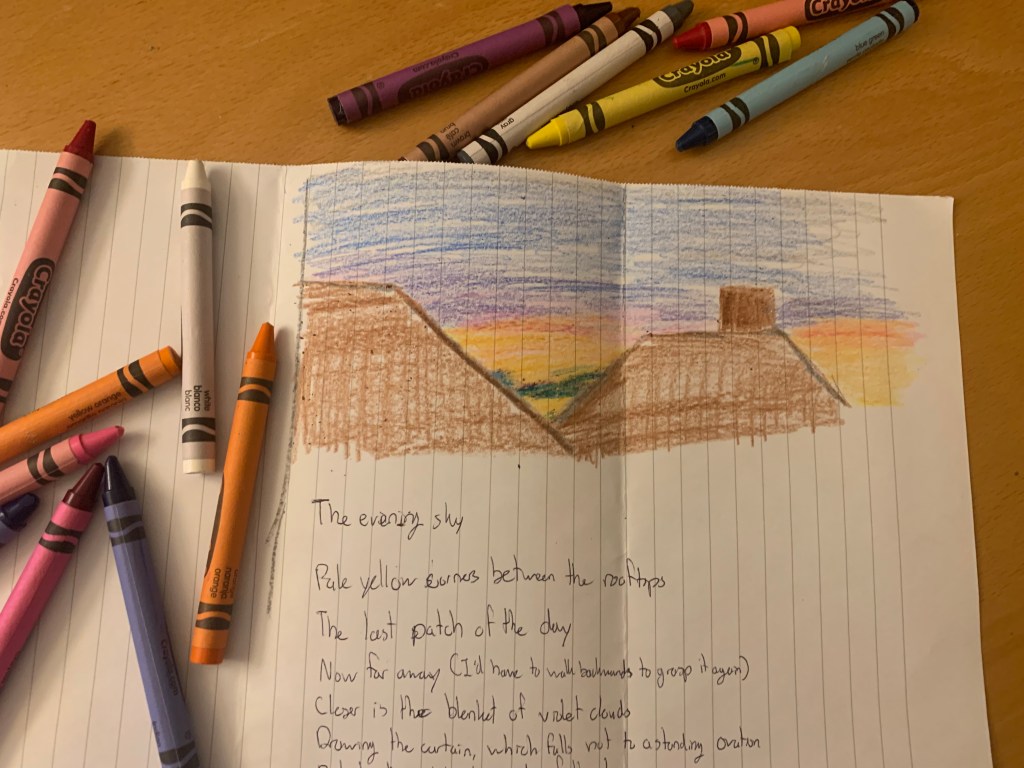
I spent a LOT of time in art museums last week, and it made me want to dwell on and understand the role of color and light in art, memory, and emotions. I learned that the impressionists approached the practice of color differently. Some like Gauguin, wanted to paint from memory, even at the cost of painting what was really there. Others, like Van Gogh, preferred to paint as closely to what they saw as possible, so they had to paint quickly to capture a moment before it changed. Van Gogh, however, famously also used his love of the simple life of farmers and the rural landscape to make sense of his own chaotic inner thought life. So I responded with the only medium I had available to me, trying to depict a sunset after an overcast, muggy day. Its not very true to reality, but that is more due to my lack of ability than to my philosophy of art. I suppose when I write poetry, I depend most on my own memory of a particular experience or feeling, and I try to connect to what I’m observing to my memory of other literature or Scripture, so you tell me which impressionist I most align with.

Anyway, please enjoy my visual art creation (crayon on notebook paper), paired with some hastily written poetry.

The Evening Sky

Pale yellow corners between the rooftops
The last patch of the day
Now far away (I'd have to walk backwards to grasp it again)
Closer is the blanket of violet clouds
Drawing the curtain, which falls not to a standing ovation
But to the muted string notes of the stars
Vibrating in graceful glory, this rotating cosmic dance
What will open at this close?

Refracted Visions of the Beautiful Life

A short(ish) summary of my labour of love

I remember wondering what on earth I would do with myself once I submitted my dissertation, because it took up so much creative energy and time. I had visions of reading piles of books and writing little articles in between shifts at the coffee shop, but in the two months since submitting, I’ve done very little in comparison to producing a dissertation, and it feels glorious. I’ve enjoyed a summer holiday pace of life, extended coffee breaks and meals with friends, processed the end of my time as a masters student, and yes, more reading (in the sun of course). I also had the chance to present a short version of my dissertation to my college, in preparation for presenting it at the International Association for the Study of Youth Ministry conference in July. Very exciting, I feel like a real academic!

Lastly, my time in the past couple months has been filled with turning my attention to what’s next, the ever-present question for a recent grad: youth ministry. After years of training and preparing, and now an extra theology degree thrown in, I feel so ready to pursue full-time youth ministry. I’m waiting with open hands for God to reveal the next step, but in the meantime, I wanted to share some of my dissertation. I have so many more questions I want to explore, but this work gave me a lovely sense of completion. I doubt very many will want to read the 20,000 word version, and only a very few more would read the 5,000 word presentation, so here is a few paragraphs summarizing my work.


I grew up immersed in books and stories. I know the transformational power of books, especially fantasy, because I was transformed by the experience of entering another world through reading. Although asking me to pick my favorite book is an impossible question to answer, I can confidently say none captured me as fully, or made me long so deeply for the feeling of something else as the Chronicles of Narnia and The Lord of the Rings. These stories of the fantastic and magical “baptised my imagination,” to use Lewis’s words, and invited me to enter a world suspended in time, returning me to my reality with fresh vision and wonder. I know now that what I experienced was a taste for the radiance of transcendental Beauty so that I saw Beauty in other experiences in my familiar world. As I now consider youth ministry practices, I desire to create space for youth to be captured by Beauty through aesthetic experience, which baptises their imaginations so that they may desire, know, and love God more deeply and participate in what I have termed ‘the Beautiful Life’ – the life for which we are created.

The Beautiful Life is life according to the symphony God has written and is writing. It is the way of the Gospel as Jesus taught and embodied it. We know it by a sense of unity and completion, harmony and order, and freedom and creativity, as it brings to light that which is hidden. It is joy from the promise of the fulfilment of all desires. In this life, we dwell with God and worship him in creative action, as we respond to his love. As we anticipate this life, we are drawn to aesthetic experiences that broaden and embody our vision of the Beautiful Life.


Before introducing aesthetic experience into youth ministry practice, we need to first understand how Beauty captures the imagination. I argue that the kingdom of God cannot be grasped by reason unless it has first touched the imagination because it communicates primarily through parable, metaphor, and images, and it is by the imagination that we ascribe meaning to metaphors and images. Imagination is the faculty by which we create metaphors to relate what is known to what is unknown, and back again. This means I want to use ‘theopoetics,’ a type of theological discourse, in faith formation to apprehend God and his work as a movement toward understanding and transformed living.

Imagination is the light by which we see what is already there, though we had not seen it before. The Christian faith claims that what is already there, the possible within the actual, is the life of the kingdom revealed by the embodied parable of Jesus. He is the root-metaphor for the kingdom, and the form of Beauty. The incarnation means our apprehension of God is not only abstract; Christ made Beauty’s communication personal by becoming a person himself, giving us concrete forma so that we apprehend God in the incarnation and create beauty from our delight in him. In his incarnation, death, and resurrection, the theodrama of Christ’s movement revealed the pattern of the Beautiful Life.

We can experience patterns of the Beautiful Life worked out in the eucatastrophe of fairytales. ‘Eucatastrophe’ is Tolkien’s word for the Consolation of a happy ending in fairytales, while ‘Dycatastrophe’ is his word for sorrow and failure. According to Tolkien, from dycatastrophe comes eucatastrophe: defeat is not the final word in either fairytales or the story of our lives. Victory comes in a “sudden joyous ‘turn.’ (See “On Fairy-Stories”) Applied to spiritual formation, this guides us in understanding God’s presence as eucatastrophic movement in our lives as we imagine the world as it could be, beautifully sung according to the shape of his kingdom, which we know because of Christ’s communication of Beauty. 


I chose to consider Tolkien, Lewis, and MacDonald partly because reading them was formational for me, and partly because I think they understood something about the power of beauty in a story. Beauty is inherent to the worlds of both Narnia and Middle Earth, which are created through song. Characters in The Lord of the Rings especially, but also in Narnia and MacDonald’s fairytales, often fight their enemies and find hope by singing and noticing beauty and light in the darkest of places. Beauty is powerful for both the characters in fairytales, and for readers, because it is the beauty of other worlds that enchant us, and then reenchant us to see our own worlds in a new light. Lewis’s own life is an example of this: reading MacDonald’s Phantastes was instrumental to his own faith because it ‘baptized his imagination.’ Lewis understood the power of fairytales for knowing God, and this truth is made more evident in Tolkien’s essay “On Fairy Stories,” which concludes with the fact that the gospel, the evangelium, is the greatest fairy-story told, with the greatest eucatastrophe erupting from the greatest dycatastrophe. The story pauses on the cross, beholding it for a breathless moment, but it does not stop there. The resurrection, and its invitation for us to follow Christ into death and life again, casts the cross in a new light, which makes all things known as beautiful.


All of this brings me to my suggested model of youth ministry that attempts to cultivate poetic spiritual formation. Poetic spiritual formation seeks to baptise the imagination, so that youth catch a vision of God’s kingdom through engaging with aesthetic experiences. We are attempting to create a framework by which youth can go on to build their embodied theology, which is worshipful in both contemplation and action. My desire is to create a program for youth ministry that uses 3 elements: contemplation, conversation and creation

Contemplation seeks to derive pure enjoyment from the object’s beauty, letting it wash over the imagination and noticing any emotions that arise. A sacramental theology of Beauty lends itself to cultivating the practice of contemplation as a way to know the love of God. Contemplation would function similarly to the practice of lectio divina, in that it would regard aesthetic objects as capable of revelation and therefore worthy of our undivided attention. It creates space for a rendezvous with God and his Being, since it is through Beauty that he communicates himself and captures our imagination.

Conversation help youth understand the experience and what the aesthetic object is saying about the self, God, and the world, since beautiful things inherently reveal truth. Through the art of perceiving what is beautiful, we help youth mature in their ability to perceive God. Conversation is the way we give youth language to articulate their experience in the light of the story of God’s kingdom. Though individual interpretations, perceptions, and experiences are vital in poetic spiritual formation – which values dynamic learning and creativity – it is just as vital to ask together how these revelations gained by poetic intuition align with historical, ecclesial, moral, and traditional continuity. Conversation then serves a double purpose of illuminating the experience for each other, and creating community and relationships between youth and adults, and among peer groups of youth, as youth learn to participate in the conversations and community of the larger global and historical church. Since the vision of the Beautiful Life is refracted, we rely on each other to see the whole.

Creative response is the last and vital part of poetic spiritual formation. Through poeima, or creative making toward and end, aesthetic experience takes hold as spiritual formation. Response is vital because poeima is fundamental to knowing; we cannot know a thing unless we make in response to our contemplation of it. This means we know the love of God more deeply when we create in love, knowing beauty as we create. Tolkien calls this sub-creation, but I’ll leave you to read the creation account of the Ainulinadalë in the Silmarillion and his poem “Mythopoeia” to explore that further.


Through contemplation, conversation, and creation, poetic spiritual formation can create space for youth to develop their imagination to reach higher and see through the window to a greater reality, while at the same time perceiving the greater reality within their familiar world. It baptises their imagination in such a way that their narrative comprehension of themselves moves forward in beauty to new creation, painted by the hope of a eucatastrophe. 


This is such a small sample, but hopefully it gives a good picture of my fascination with Beauty and heart for youth ministry. If you really are interested in reading more about my philosophy of imagination, theology of beauty, theopoetic methodology, and exploration of the nature of fairytales, I am more than happy to send the full text!

Look East

Having finished my favorite book of Dante’s Comedy as part of the 100 Days of Dante project, I’m sharing this poem that I wrote as I was reading it. It reflects my current fixation with light imagery and my lifelong love of mountains. I’d like to say that I put much creative effort into crafting it in terza rima, Dante’s chosen poetic form, but I didn’t. Someday when I have more creative space, I would love to work on writing poetry in more form because I really do think that the boundaries of form make poetry more free and beautiful, but for now free verse will have to do. Enough preamble, here it is.

Reflections on Purgatorio

Look East
Towards the rising of the Sun
When the grey sky feels too vast
and the mountain you find yourself on is unkind

Turn to find the glow
Distant but steady, steadily
Follow the shrinking shadows

Let the golden light at your back raise you
With its weight until you can bear the weight
Up through flames that will burn all of you away
So all that's left is you

This moment of yearning in your in-between
Is the transfiguration in the dark of all you knew
Into all you desire
Let it fill you, drink deeply the light

And when the sun carries through its course
Look up
See the stars
Hear their music that calls you
Sing it with them
Sing it out, or sing the harmonies within you
Sing in joyous mourning, in mournful joy
Sing, and awake the dawn

Relational Liturgy

The Liturgy and Worship of Youth Ministry

This essay was written for the Liturgy and Worship unit of the MTh program, and my question was: What is the ‘liturgy’ of American evangelical youth ministry in the western United States, and how could it be better shaped for discipling young people into worship? It explores many questions I’ve had about what youth ministry needs and what my vision for ministry will be as I look to the future. As with my other blog posts of my submitted work, this is only a small piece of a much larger essay and written in a less academic voice, so if you are interested in reading the whole thing, I’m very happy to send it if you get in touch with me!

Every church has liturgy, whether it would call itself a ‘liturgical church’ or not. Though many churches in the evangelical tradition in the United States would resist liturgy, viewing it as stifling, inauthentic, and dry, they keep to regular patterns, traditions, and practices that could be classified as ‘liturgy.’ American evangelical youth ministry (AEYM) is no exception, and, in the practices of its weekly meetings and annual rhythms, follows a pattern that aims at forming youth in a certain way. The key then to effective youth ministry is to examine the existing liturgies to ascertain how it is currently forming youth and how it might be better shaped according to a theology of worship. 

Liturgy in this essay is defined as “culture-defining practices.” It is based on Smith’s understanding: “liturgies [clarified in a footnote as a synonym for worship]—whether ‘sacred’ or ‘secular’—shape and constitute our identities by forming our most fundamental desires and our most basic attunement to the world. In short, liturgies make us certain kinds of people, and what defines us is what we love.” (Smith, Desiring the Kingdom, 25) We are looking here at what we love through what we do.

To expand on the context, I discovered that “evangelicalism” is incredibly broad in its practices, beliefs, and traditions, but basically, evangelicalism stems from the Protestant Reformation and holds to sola Scriptura. Evangelicals are cautious about holding “tradition” in authority as it is considered limiting and adverse to the “seeker friendly” value of many evangelical worship services, which often strive for authenticity through open worship.[McGrath, “Faith and Tradition,” Oxford Handbook of Evangelical Theology, 91] This is reflected in the practices of youth ministry, which seeks to be relevant and limits aspects that would put off those not familiar with church and its traditions. 

Evangelical churches may consider themselves non-liturgical, but liturgy here includes practices and rhythms that actively shape habitus through desire. Our embodied, ritualistic practices reveal what we desire more than professed statements of belief or than what we think we believe. Any liturgy identified in youth ministry, then, is the practices that form the heart, embodied in ritual and repetition. 

The ritualistic repetition of phrases and rhythms of traditional liturgy gives worshipers freedom of expression within helpful parameters and with practiced ease. Garrigan writes, “The point is that liturgy shapes us not as automata, stuck repeating a limited repertoire of given acts, but as free agents, artists really, trained to act in a whole heap of ways in response to a whole heap of situations. By engaging our whole selves, body and mind, over and over…we become accomplished improvisors.”[Garrigan, “Ethics”, Study of Liturgy and Worship, 200] Like pianists must practice scales and understand music theory in a deep sense before playing complicated pieces, or improvising in jazz sets, the repetitive actions of liturgy performed day after day, week after week, year after year, effectively form a person’s whole being, allowing them to “get the Story.” 

Considering worship as participatory action in God changes it from a weekly rehearsal to a transformative experience because it is a space for the worshiper and God to meet that happens through liturgy, which builds a habitus of worship through aiming and ordering desires so that living like Christ extends beyond a weekly service. In the same way the pianist practices scales so she can produce beautiful, complex music, we transform liturgy for effective ministry by examining the end toward which the liturgy is aimed, what music is being performed.[Smith, Desiring, 34]  Liturgy’s structure helps give meaning to the self and the individual’s place in a larger community and world, which is the desired end of the adolescent life stage. In attempting to live a God-honoring life, liturgy as repeated practices help Christians develop theological habits of a worshipful life that extends beyond the youth ministry gathering by “training our hearts through our bodies.”[Smith, Desiring, 25]

Youth ministry faces a difficult challenge: an increasingly postmodern, post-Christian culture, and a generation that rejected religion and tradition in favour of individual success and truth, with access to more resources yet experiencing less community than ever before. To minister to this lonely generation, youth ministry must reintroduce youth to the Church through the person of Jesus Christ. If postmodern youth are going to be interested in Christianity, it is because it fulfils their need for identity security through relationship with Christ, and youth ministry can help meet this need by giving structure to relationship-building with Jesus and the Church through carefully aimed practices.

AEYM must find the balance between contextualization and adaption and communication of the true gospel. One way it attempts this balance is through a relatively recent model of youth ministry: incarnational ministry, championed by Root in the US and Ward in the UK. They claim that as Jesus was incarnated among people and related his gospel message in a compelling way, ministers should also be “incarnate” in youth culture, and as Jesus maintained his divinity though incarnate, pastors communicate the essential message of the Gospel. This model is an effective response to postmodernism by using relationship instead of religion to reach youth; however, the incarnational model threatens to sacrifice tradition for the sake of relevancy, especially in an evangelical context which has already loosened its ties to tradition. The focus on relationships as an end is often guilty of “theological shorthand,” using theological phrases lifted from Scripture or creeds without a full understanding of their depth.[Baily, Youth Ministry and Theological Shorthand] Liturgy that explicitly communicates doctrine is essential for the incarnation model. Liturgy-shaped theology re-grounds practice in tradition and becomes a “counter-pedagogy”[Smith, Desiring, 24] to postmodernity’s aversion to objective truth from a higher authority and Gen-Z’s aversion to communal identity and morality. When AEYM talks about imitating Christ, it must think in terms of becoming Christ, embodying his sacrificial love and taking on his holiness. Christ must remain the telos of youth ministry practice, and not just the incarnate Jesus. Before thinking about how the liturgy needs to be better shaped, we need to look at what liturgy actually exists in AEYM, keeping in mind that liturgy is practices that form the heart.

To do this, I took a survey, asking youth pastors to list their practices and why they do them. I got a smaller-than-expected response, but it confirmed what I suspected. Most youth groups use teaching, bible-reading worship, prayer, small group discussion, and games weekly or close to it. There is little presence of traditional liturgical practices, and the annual rhythms and celebrations match up with the school year rather than church calendar. In questions about goals, there was a heavy emphasis on relationships, again aligning with my research into current youth ministry literature. 

What I found most fascinating about the results was that most youth pastors could easily report why teaching, bible-reading, worship, and small group discussion contributed to their discipleship goals, yet not one articulated how games fit into their goals, though they are almost universally used weekly, and many youth pastors said they put on fun events and programs annually. From my experience, if students are asked to look back on their favorite parts of the year in youth ministry, chances are they are won’t say the sermon series or time of prayer, but the overnighter where they stayed up all night playing dodgeball, or the park day when the youth pastor got pied in the face. Those in youth ministry know from experience that these games often take up the most resources and time, so why can’t we say why we do them? I highlight this not because I think we should cut out games and all the crazy youth ministry events, but because I think we need to better consider how these are forming youth since they are so vital to youth ministry: If we are so eager to reach out and build incarnational relationships with students, how can we do that through games?

I suggest in my application that we consider relationships not the end of youth ministry, but as a liturgy in itself. We must remember that we are introducing them to Jesus, so youth pastors using an incarnational model can be dialogue partners with youth, revealing who God is through their relational “communicative acts.” For ministry without creeds, dialogue is the confession of youth ministry, emerging through the liturgy of relationship when ministers interweave gospel truth into youth culture: “Wise contextual witness that moves beyond purposeful presence to speaking about the story amongst young people needs to be employed or rediscovered.”[Smith, Desiring, 234] The move from presence is key because “speaking about the story” is how teenagers hear the explicit gospel, to reject or accept.[Dean, Almost Christian, 191] Pastors admirably pursuing ‘place-sharing’ from Root’s model must consider how they can speak the story through established practices and disciple young people into worship. It may not be helpful or realistic to introduce traditional liturgical practices into youth ministry; that has to be up to the youth pastor to decide if the youth group would benefit from declaring creeds, confessing publicly, participating in advent or lent, reciting communal prayers, or any other practice evangelicalism has excluded. What I do think we need to do is carefully examine our practices and how can they really form youth’s heart toward worship. Teaching edifies youth with an accurate view of the God they are worshiping. Communal singing and prayer are expression and declaration of the Spirit’s truth, and a moment to live in relationship with God. Small group discussions help youth understand what they have been taught and consider how they might take it into their daily lives, building Christian character. Relationships, if considered liturgy, communicate Christ’s love and invite youth into relationship with God through Christ. Even games can be used for worship, as they welcome youth into community. The key is keeping sight of the original end of each practice: glorification of the God who invites his people into relationship with him. 


There’s certainly more to this question, and I’m sure I will be considering it for the rest of my ministry. It makes me excited to pursue my calling as I continue this degree and attempt to bridge the gap between theological studies and ministry! Thank you so much to those who answered the survey, your input was so helpful and it was inspiring to read how you teach and care for the students in your ministry!

Learning to Rest

This essay was written for the Spirituality unit of the MTh, and my question was: How might the sovereignty of God frame the spiritual discipline of rest, and how could that be applied to those in church ministry? This basically means I’m asking why and how pastors should rest. As with my other submitted work I’ve published here, if you would like to read the full essay, please get in touch with me and I’m very happy to send it!

I go among the trees and sit still. 
All my stirring becomes quiet
…
My tasks lie in their places
where I left them, asleep like cattle.
…
After days of labor, 
mute in my consternations, 
I hear my song at last,
and I sing it. As we sing,
the day turns, the trees move
.

-Wendell Berry, Sabbaths (I)

Berry’s poem on the Sabbath speaks to the soul’s deep need to be still, away from tasks set aside, and it describes how those tasks are again taken up. However, this state of rest is difficult to enter, and as a result, work is more often slog than song. Without rest, pastors are inhibiting gospel work in their lives and ministry, so their work, meant to be fulfilling and glorifying to God, becomes first self-serving, then toilsome and draining. The relationship between humans and their work and rest have been broken and must be restored in order for pastors to do kingdom work.

Work is biblical, and vital to being human. However, work, when it becomes one’s way to find fulfilment and significance, leads to burnout. Vocational ministry is especially in danger of burnout, since pastors often have difficulty establishing boundaries between work and personal life; a pastor’s spirituality and relationship to God could be inseparable from the work of ministry. Pastoral burnout is therefore a vicious cycle of corrupted work and potentially breakdown of self, since ministry calling, identity, and spirituality are intertwined. This problem cannot be solved by giving pastors more time off; it is a deep-seated issue of a pastor’s holistic spiritual state, as Peterson, a pastor himself, questions, “if I vainly crowd my day with conspicuous activity or let others fill my day with imperious demands, I don’t have time to do my proper work…How can I lead people into the quiet place beside the still waters if I am in perpetual motion?”[Peterson, The Contemplative Pastor, 19] The cure for burnout is rest from work “beside the still waters” to regain a sense of self and purpose of work, found in Genesis’ creation account.

Genesis 1:28 shows before the Fall, humans were tasked with work to do, according the inherent image of God. Their dominion, given by God, required attending, and included the gift and task of creating life. Humans in the garden were commanded to pattern their work after God’s and establish dominion over the earth by naming it and tending it so that it too creates life. Fulness of being was found through satisfaction in working in complete freedom toward their end of glorifying God.

Life in the garden was not meant to be solely work, however. The image of God and the creation mandate includes periods of rest from the work of creation, demonstrated first by God in Genesis 2:1-3. He stopped his creative work, recognizing the goodness and completeness of his work. Augustine describes God’s rest: “God knows how to be active while at rest, and at rest in his activity. He can apply to a new work not a new design but an eternal plan; and it is not because he repented of his previous inactivity that he began to do something he had not done before.”[Augustine, City of God, XII.18] God’s rest on the seventh day acknowledged the completion of creation and his new work to sustain it through man. He rests in his activity because he knows his eternal plan, and humans are meant to rest in the same way.

Before the Fall, humans did not need to rest because of weariness or exhaustion; instead, rest was a recognition of completed work. Humans did not identify themselves by their work, nor did God. By resting, God declared that it is good to enjoy what has been accomplished, not for the sake of accomplishing more after the period of rest, and God is still God when resting. To experience Sabbath, this period of kairos time that has been blessed and set apart as a time to not create, is to experience the fulfilment and completion of work, and humans are created to enjoy this divine blessing.

However, humans’ relationship to work and rest changes after the Fall, damaged by pride. Humans now bear a curse; no longer is work a joyful, worshipful experience. It is now wearying and fruitless. Humans’ enmity with God, each other, and nature, makes the work of tending the earth a struggle that more often than not ends in failure. Because human’s relationship to God is broken, humans no longer desire or know how to glorify God through their work. Instead, humans redefined work as an attempt to create significance, in other words, glorify the self. Humans are created to matter and be fulfilled, but finding significance and definition in solely work, making work its own end, is a symptom of the Fall. 

Post-Fall, God invites humans rediscover the true purpose of their work by giving them a command to rest.[Exodus 20:8] Israel has just liberated from slavery in the land of Egypt under a Pharaoh who thought himself God, so this new command to remember the hallowed day of the Sabbath is a declaration that the true God is not one who demands productivity from slaves, but who gifts his creatures with the ability to create. The fourth commandment was a gift to humans to recall the original created state, where it was good to stop labouring for a time, and to remind them of God’s provision in their newfound freedom, expressed through his covenant.

Because of their fallen nature, however, trying to keep the Sabbath holy became another constraint, rather than an invitation back to the freedom of the Garden. Dressler writes, “Instead of understanding it to be their privilege to rest on the Sabbath, they viewed it as deprivation; instead of recognizing their opportunity to commune with God, they saw only inconvenience and hardship. Rather than discovering freedom to worship, they felt in bondage to a law, and instead of grasping the idea of renewal of their covenant relationship to God, they experienced the tragedy of legalism.”[Dressler, “The Sabbath in the Old Testament” From Sabbath to the Lord’s Day, 34.] We are still in danger of legalistic Sabbath practices if they focus on producing more, rather than renewing a relationship with God and remembering his covenant. Work and rest need redemption; otherwise, work becomes our identity and rest becomes an enslavement.

Jesus, by his proclamation of the kingdom of God come, offered a way for both work and rest to be redeemed through an invitation: “Come to me, all you that are weary and are carrying heavy burdens, and I will give you rest. Take my yoke upon you, and learn from me; for I am gentle and humble in heart, and you will find rest for your souls. For my yoke is easy, and my burden is light.”[Matthew 11:28-30] With these words, Jesus reminds them of the original purpose of the Sabbath and redefines it under his new kingdom rule. Rest for the weary is laying aside their burden to take on Jesus’ yoke. This rest keeps us free from imposing more rules and laws on ourselves that only add to our burden, which is the freedom Jesus came to give us. Sabbathing with Jesus Christ as Lord of the Sabbath is now not only a reminder of God’s past creation and provision; it is an anticipation of the future kingdom.

The key then to rest is an eschatological kingdom orientation, as Hebrews 4 reveals: “while the promise of entering his rest is still open, let us take care that none of you should seem to have failed to reach it…So then, a sabbath rest still remains for the people of God; for those who enter God’s rest also cease from their labor as God did from his.”[Hebrews 4:1,9-10] This promise of rest is presently open to experience for those who “received the good news”[Hebrews 4:6] by faith and reminds us of God’s rest in Genesis. By participating in Sabbath rest now, we anticipate the coming of God’s kingdom, which means completion of our work and perfect rest. In this kingdom there is no need to create significance for oneself out of pride or insecurity because humans rest in the faith that they are significant.

Here, I embarked on a rather long discussion on the sovereignty of God debate. The purpose was to show that God is certainly sovereign and fully reigns in his kingdom, but it is a sovereignty that allows for creativity and active participation from us as creatures. By aligning our will to God’s through spiritual formation, we are free to rest and work as we were created. Dallas Willard’s The Divine Conspiracy was most helpful in considering this.

Turning to application, ‘rest’ needs a definition. The ‘spiritual discipline of rest’ is differentiated from ‘Sabbath rest’. The discipline is juxtaposed to activity, requiring a cessation of regular work. It can consist of many different Rules of Life, depending on what is life-giving for individuals, but the purpose of them should be to set apart the period of time from regular work. Sabbath rest, on the other hand, is the spiritual reality towards which the discipline of rest aims. It is a state of spiritual being where the soul is at rest in God, after Augustine’s well-known prayer, “our heart is restless until it rests in you.”[Augustine, Confessions, 3] Someone in Sabbath rest can be working, since Sabbath rest is not mutually exclusive to work, but it is working with the completed end in mind and in alignment with God’s kingdom.

Pastors especially must be intentional in their rest since everyone else’s Sabbath day is a pastor’s busiest, and ministry demands are not limited to a normal 9-5 schedule. Spiritual rest cannot be dropping from exhaustion; that would be burnout from corrupted ministry work. Instead, rest is choosing to set aside time to “practice the presence of God”. Slee writes Sabbath is not “space for a different kind of doing…Sabbath is a different kind of space altogether, when we are invited into not-doing, not-knowing, not-intending, not-working, not-pursuing.”[Slee, Sabbath, 81] The spiritual discipline of rest is instead “not-doing”, a bodily engagement in a spiritual reality. Pastors need this space if they are to do ministry so their self does not get inhibit kingdom work.

A heart at rest in God will turn to its work, acknowledging God’s presence and movement of his sovereign will. We anticipate a final rest, but that does not negate the goodness of work now. The discipline of rest contributes to work done in Sabbath rest. It is still good to work, but living under the sovereignty of God changes our posture towards work. In the same way that rest necessitates an eschatological mindset, so fulfilling work requires a view toward transformed creation. Work is in cooperatio Dei, which trusts that even daily ministry operations contribute, through the effective nature of God’s love, to the coming redemption of creation. The work of ministry takes on a new meaning because it is not done for its own sake, nor is it done to satisfy a need in a pastor. Burnout poses no threat to the pastor who works in a Sabbath because that pastor knows the end of his or her work is not fulfilment or glorification of the self through accomplishments. Rather, the end of pastor’s work is rest, so ministry is resting in activity, as God did, and expresses of God’s gift of creativity and co-operation according to his eternal kingdom. Only then can they take up work with a Sabbathing spiritual state, “to hear our song and to sing it.”[Slee, Sabbath, 155]


What I most enjoyed about writing this essay was learning about spirituality traditions and disciplines. If you are interested in reading more on rest or other spiritual disciplines, I’m happy to share some of the books I found most compelling and formative!