Looking Back

Its been a hot minute since I’ve posted on my blog, and a few people have asked about it, so here is a short reflection and update on my Oxford journey since I’ve been home for summer for a little over a month now.

It is really difficult to sum up the past year for people who ask. It reminds me of coming home from my high school mission trips because I never know quite what to say or what people really want to hear. Do I give the short answer with only the happy highlights?How do I skim over the hard parts that I haven’t fully processed myself without being dishonest or sounding fake? What picture do I need to paint in this short conversation with people who I’m asking to help fund the next year?

I’d rather not sugarcoat, so I won’t. This year was really hard. I often doubted my purpose there and whether it would have been wiser to wait, and the loneliness that usually accompanies moving abroad increased dramatically because of the heavy, sometimes even oppressive, restrictions of Covid. I didn’t succeed academically in the same way I’ve spent my whole life succeeding, so I questioned who I am if I am not sailing through school with straight A’s at the end, but struggling to figure out my course and only achieving average marks for my first submissions. I didn’t even have ministry to fill me up because I barely had the capacity to be ok for myself, much less to be able to serve in ministry. 

In many ways, I felt stripped and bare, a state which I would have never let myself get to under normal circumstances, but I think that God really wanted to use this time and these struggles to show me what it is to be just me in front of him. Me, without my achievements, strength, people, comforts, ministry. It was painful, like Aslan clawing off Eustace’s dragon scales (see Voyage of the Dawn Treader) but it was so good because His presence was so near, and the pressure is off. No performance, no efforts to earn, no trying to guess His will. Just trusting in Jesus, abiding in the Father, and listening to the Spirit. This year was way less about learning how to do applied theology in an academic context and way more about coming to a beautifully vulnerable trust in God.

Of course, this is not to say that it was all painful and hard. I had some people who helped me find some genuinely sweet and even fun moments as we settled in, and there were plenty of things to enjoy about my life in Oxford. Being back in school was a joy, and I absolutely love my job at the coffee shop. I even got to travel and explore a bit at the end of the year, and there will definitely be more opportunities to travel this year. I can confidently say that at the end of all of this, I will have gone on an adventure well worth the dangerous business of stepping out my door.


I also get asked fairly often on the progress of my fundraising. Honestly? Slowly. I was frustrated at first, especially when I compared it to other’s success stories. I’m not sure if I truly believed I would get fully funded through donations, but I hoped. I’m sure I could be putting more effort and strategy into this endeavor, but I’m not a fan of promoting myself or emotionally manipulating people. Really this turned into another subverted expectation. It was never about the number that I raise, but about learning to trust God. In order to ask people for money, I have to believe so deeply that God called me to Oxford at this specific time and that it is worth asking people to come alongside and be a part of it. It was drilled into us at Biola that you can’t do ministry alone, you need a team and the church behind you, so why should I prepare for ministry alone?

Whether or not the entire amount comes in, I’m pressing on and following God’s call back to Oxford in the fall, and trusting that He’ll be faithful like He’s always been before. I continue to communicate my needs, asking first and foremost for prayer as the most powerful way to partner with me and whatever God is doing in me and through me in this season in Oxford. 


So what’s next? A little more time at home, where I’m thankful for the freedom to rest and reflect while working on my next essays due at the end of September. Some visits with dear friends, lots of walking the dog, evenings with family. Prayerful preparation for heading back to Oxford for what I’m sure will be a full year. Beyond that? I really can’t say, ask me again a year from now.

Thanks for reading. Thanks for praying. If your time with God in prayer for me inspires you to give financially, here’s a link to my GoFundMe page, or you can get in touch with me to give another way. 

Further up and further in, friends.

The Feminine Imago Dei

This is part of the second of two papers I submitted for my most recent deadline. It fulfils a unit called “Experiential Project with a Theological Reflection.” You’ll notice that this one is much more personal, since I reflected on my experience in ministry as a single woman. For the actual paper, I incorporated the experience of several other women. This post is only my own experience, and as with my previous post, I’m very happy to send you the full paper if you get in touch with me personally! I learned so much about myself and how to see God in new ways through writing this paper, and I’m excited to share some of what I discovered here!

I first felt my own call to ministry when I was fifteen years old. I was training to be on staff at a summer camp, and I felt something light up inside at the opportunity to disciple young people by engaging them in relationship and sharing what God was teaching me. From that week on, I knew that my life’s work would always be about teaching young people to love God. This call took me to a private university after graduating high school, where I completed a degree in Christian Ministries. During that time, I became the intern in the student ministries of my new church. The theory I learned in classes alongside hands-on ministry experience confirmed my calling as I found fulfilment and joy in discipling students.

It was not until I arrived at university that I learned about the controversy of women in ministry. I was confused by the positive and negative reactions I got when sharing my calling because I knew I had gifts for teaching and leadership in the church, confirmed by trusted mentors and peers, and I had already started using and strengthening those gifts. I did not know that many churches would severely limit the roles I could hold because of how they read Scripture. I realised then within the church I grew up in, women could be on staff and teach youth, but they were never given the title of pastor or the opportunity to teach to the general congregation. These barriers did not make sense to me because I had been greatly influenced by the leadership and teaching of both men and women working in youth ministry.

I also found that my desire for a meaningful career was off-putting for those who came from contexts that held to traditional family structures. Many of my male professors and other youth pastors talked as if it was assumed that I could work in the church until I had children, at which time I would automatically step down to be a stay-at-home mother. The same assumption was not made for the men on my course since culturally it is more acceptable for men with families to work outside the home, and it frustrated me that these people who did not know me or my call made that assumption for me.

These types of interactions caused me to question my calling and place in the church as I prepared to graduate and start a ministry career, unmarried. If my most valuable contribution to the church was, as many communicated implicitly and explicitly, as a wife and mother, what value do I have without those roles to define me as a woman? While I do have a desire to be married and have children, I struggled to find definition and expression of femininity without that. Ultimately, I chose to believe that I have value in the church for myself, but I needed to understand how much being female does and should affect my life, my ministry, and my relationship with God. I could see that I as a female add something unique and valuable to youth ministry because I thought, felt, and acted differently than my male peers. My feminine nature creates different community, and my female voice is necessary to speak to the needs of the ministry, especially for young girls. Outside of ministry, I experienced an incredibly beautiful image of God in my community of women. We constantly pour ourselves out for each other knowing we will be poured back into, demonstrating God’s love in sisterhood. I wanted to find a way for female expression and relationship to be celebrated and encouraged. 

When looking for ministry positions, I heard back from many churches that I was not qualified enough for the youth pastor position, but that I should apply for an open children’s ministry position, even though I am not called or qualified for children’s ministry. I have sat at tables full of men who do not know how under-represented half their ministry is. I have heard countless times the deliverer of a sexist joke justify it, saying it was “made in love,” not understanding its true demeaning nature, or how that language and attitude draws divisive lines when we should be working towards unity in the church. I have felt overlooked, dismissed, and unheard. Despite all this, I know my value lies in the power of the image of God, and I hold fast to my conviction of being called to youth ministry. The limits imposed on me by some in the church do not align with my calling and gifts and, more importantly, with what I believe Scripture says.

So God created humankind 
     in his image, 
in the image of God he 
     created them, 
male and female he
    created them. (Gen 1.27)

From the beginning, humankind was made in two genders, both in the image of God. I argue that the creation account tells us that one gender is not more valuable than the other, nor does one more fully reflect and bear the image of God than the other.

For the image of God to be redeemed within humanity for both men and women, we first need to understand God. Godlikeness is not found in being male, but that is not what our language of God communicates. In the majority of church tradition, God is referred to as “he,” with his traditionally male aspects emphasised. It is with few exceptions until the emergence of feminist theology within the twentieth century that women have begun to question this assumption, and it has been to the detriment of our understanding of God and the flourishing of his kingdom.

Lest you think I am suggesting we throw out all gendered language of God, please hear me: there is value to knowing God through our human understanding of gender. Jesus taught us to pray to God the Father, which personally brings me great comfort and understand his fatherly protection and provision. However, praying to God the Father does not mean we cannot also understand him as Mother, since God reveals himself as mother: “As a mother comforts her child,/ so I will comfort you.” (Isaiah 66:13) All the names of God help us to know him more deeply, as well as ourselves and our relationship to him, which leads to better relationships between people. Some names and images of God may speak to us more powerfully in different seasons for different reasons, but we need them all. The beauty of a loving mother-daughter relationship is caught up in God’s image, and we lose that if we ignore God’s femininity. Femininity is a gift that allows women to know God. They do not have to relate to a God who does not know what it is to be female, nor do they have to look outside of God for a definition of female and femininity. 

Understanding God in his fullness helps us to understand ourselves because we were made with the imago dei, and that includes gender. There is value to the distinction between male and female in both body and spirit because female will always be included in any identity I hold: female Christian, female student, female pastor, daughter. The way I reflect the imago Dei is from femininity. Yet eschatologically, we transcend the need for gendered definition. Paul’s formative statement, “There is no longer Jew or Greek, there is no longer slave or free, there is no longer male and female; for all of you are one in Christ Jesus”(Gal 3:28) describes a new reality of being because new life in Christ is now available. The only distinction that matters here is dead or alive, old or new, redeemed and free or enslaved to sin. These are the lines kingdom of God draws, and one is saved not by his or her race, class, or gender, but by being in Christ.

We need redemption, not because we are women, but because we are lost people who have identified with the world and the flesh and who are invited into relationship with the Creator.


Though parts of my ministry journey have been difficult, I found freedom when I stopped focusing on what I can or cannot do, and instead served the people God put into my life that need to experience his love. God has not asked me to change the minds of church leaders so that I can hold any leadership position; he has called me to teach people how to love him, inviting others to live out God’s identity for them. Being feminine in ministry does not mean being demure, submissive, or timid because God’s love is not passive. This reflects the feminine God (sometimes named Sophia), who speaks out boldly against injustice (Proverbs 8:20) because it is an injustice when women are denied the ability to pursue their calling. It damages not only the women in leadership, but the entire church. During my ministry internship, I found that more often than not, what was needed from me as the only woman in youth ministry staff meetings was a strong voice bringing to attention the young girls in the ministry whose experience was not known to my male co-workers. I am feminine in ministry because I embody Sophia God in the way that I listen, comfort, toil, support, strengthen, and love. 

The church needs women being feminine in ministry in order to wholly carry out its mission. Young women need role models because they need to see they too have a place in the church alongside the men. They need spiritual mothers reflecting God as Mother, who could be single or married woman, as well as spiritual fathers reflecting God as Father. When a woman’s relationship with God is the foundation of her ministry, she does not need to fear getting lost in ministry by giving herself completely. Being enveloped by God is losing ourselves in him so that the first relationship that defines us is our relationship with him. The body of Christ suffers when some of its members lack identity and freedom, and each has a part to play as we “nudge” each other toward a new whole of humanity. Sometimes the work may look like a conversation around a welcoming table; other times it may feel more like a fight on a battlefield. Either way, our understanding of the imago Dei in individuals and communities informs our response to injustice, whether that is male-dominated language of God, under-represented women in the church, or more serious injustices to women across the world. 


The project of feminist theology cannot be undertaken only by women to be successful and open the way for human flourishing; all women and men have a part to play to contribute to the unity of the body of Christ, since “If one member suffers, all suffer together with it; if one member is honored, all rejoice together with it.” (1 Cor 12:12-27) Zoe Bennett Moore writes, “Flourishing speaks of growth and thriving, of beauty and nourishment…A community flourishes when it is rooted and grounded in that which gives life—in the presence of God and in the practice of justice and love.” (Introducing Feminist Perspectives) The church must examine its traditions, practices, and culture to look for ways where it inhibits movement toward the new whole. Each individual must look at his or her own relationships, heart posture, and language to examine honestly how well he or she loves others. When the imago Dei flourishes in individuals, it flourishes in the community. By the grace of God, the imago Dei has the power to work within each of us to transform the self and the community.

Priesthood and Prayer

This is part of a much longer paper, the first one that I submitted for my Masters of Theology in Applied Theology course. It is for a unit called “Doctrine, Context, and Practice,” which are the basic building blocks of Applied Theology. If you are interested in reading all 7,000 words of the paper, let me know and I’d be happy to send it to you personally! Meanwhile, this gives you a taste of what I’ve been working on for the past 7 months.

This is for the Christian who feels helpless. The one who aches at the injustice of being out of control. The one who has tried positive thinking and hard work to no avail. The one with nowhere to go, no more resources to draw on, no more self to give. Ever been there? This is for you.

As Christians, we are taught to pray always because our faith is supposed to help us in hard situations, but sometimes it feels like prayer accomplishes very little. Our situation stays the same, and talking to God about what’s going on doesn’t always change our feelings, so it feels like a risk of faith to pray. The goal of this project is not to address questions about why God might not answer intercessory prayers from faith-filled Christians, nor does it seek to address why a good God would allow suffering. Instead, it seeks to find a source of comfort through prayer. We need to know that our suffering is known, and that in our helplessness, there is someone who is not helpless. We need to know that God is near. But what kind of help, and how do we get it? 

I found one answer to that in Hebrews, in Jesus Christ, who “In the days of his flesh, Jesus offered up prayers and supplications, with loud cries and tears, to the one who was able to save him from death, and he was heard because of his reverent submission.” (Hebrews 5:7) In order for us to pray like Jesus and frame other Scripture about prayer, we must understand that He prayed as high priest and as a sacrifice. Though the concept of “priest” as person leading a church might not be familiar to you, as it wasn’t for me, a deeper engagement with Jesus’ role as priest through Hebrews can still illuminate how God made his presence open to his people.  

“Since then, we have a great high priest who has passed through the heavens, Jesus, the Son of God, let us hold fast to our confession. For we do not have a high priest who is unable to sympathize with our weaknesses, but we have one who in every respect has been tempted as we are, yet without sin. Let us therefore approach the throne of grace with boldness, so that we may receive mercy and find grace to help in time of need.” (Hebrews 4:14-16)

Hebrews answers our question: through a confession of faith in a new priest who has already made an atoning sacrifice, we can approach the divine presence and find comfort. There is no longer a barrier between us and God because Jesus’ physical and spiritual sacrifice. Though it may feel like God is far, we have the ability to come near to him. His presence is open to us.

A major project of Hebrews is to rekindle the faith of its audience in Jesus Christ, so it explains at length the significance of Jesus as both God and man, divine and human. Without this dual nature, he could not have atoned for our sins. More than that, his dual nature means that he has felt our weakness. His suffering was marked by vulnerability as he was “handed over.” However, he also achieved victory over sin, and he sits at the right hand of God now, interceding for us. The only thing required from us now to enter into God’s presence and obtain his favour is the sacrifice of obedience from faith in Christ. 

            (There is a really long section here on Calvin’s Christology. Basically Jesus did something really cool as priest and opened the way for us to approach God’s throne with boldness. He says, “there is no access to God, for us or for our prayers until the priest, purging away our defilements, sanctify us, and obtain for us that favour of which the impurity of our lives and hearts deprive us” Institutes, II.XV.6)

Be careful when you read “sacrifice”; God doesn’t want actions, and we certainly cannot save ourselves. What he does want is an obedient heart. He wants all of us. As Henri Nouwen writes in Spiritual Formation, “Prayer is standing in the presence of God with the mind in the heart—that is, in the point of our being where there are no division or distinctions and where we are totally one within ourselves, with God, and with others and with the whole of creation. In the heart of God the Spirit dwells, and there the great encounter takes place. There, the heart speaks to heart as we stand before the face of the Lord, ever present, all seeing within us.” A prayer of faith for the believer imitates Christ’s prayer. We come with an almost paradoxical heart posture, of humility in weakness and boldness of faith, to be united with a loving God. We come believing “that we are to call upon God without fear, since we know that he is propitious to us, and that this may be done is owing to the benefit conferred on us by Christ…so that nothing appears [at the throne] but grace and paternal favour.” (Calvin in his commentary on Hebrews)

Prayer becomes sacrificial obedience that unites us with God when we hold fast to our confession of who God is and who we are, in the same way that Jesus prayed in obedience and came to the conclusion, “yet, not my will but yours be done.” (Luke 22:42) Jesus, at his weakest and most vulnerable, prayed to God the Father. He lamented, laying himself bare and giving responsibility for his suffering to God. Hebrews exhorts us to do the same, with the added assurance of victory achieved in Christ. The act of sacrificial obedience through prayer will not save us; Christ saved us from our sins and made a way to approach the throne of God, and our prayer in suffering is simply an acknowledgement of that. So then, prayer is an act of faith. As Moule writes in his commentary on Hebrews, “Thus the Epistle, on its way to recall its readers, at a crisis of confusion and temptation, to certainty, patience, and peace, leads them—not last but first—to Jesus Christ.”

So pray. Pray without ceasing, in all seasons and about everything. As Lewis writes, “We must not be too high-minded. I fancy we may sometimes be deterred from small prayers by a sense of our own dignity rather than God’s.” (Letters to Malcolm) God wants to hear the cares and worries on your heart, and your suffering is known. You, in your suffering, are known.


Paying Attention

Fun fact: I’m writing this while sitting on my desk (not at, on), which is the best way to get as much sun on my face as possible. Vitamin D is a hot commodity in the UK, especially in lockdown. Speaking of lockdown…

I’m very fed up with lockdown. Most days, I’m fine with it, I really am. Wearing a mask is no different than wearing a jacket, and I don’t often think about how long its been since I sat down in a restaurant. I go about my work and I meet with people for walks whenever I think I might go crazy from sitting at my desk. It’s better to ignore the question of when will it end and just accept that this is how things are. Every now and then, though, I lift up my head and look around, or the faintest memory of a semblance of “normal life” breaks through the clouds. I’m faced with a choice in those moments: do I push it back with distraction, or do I lean into it? And if I do lean into it, do I stop when I feel frustration and self-pity, or do I dig deeper and attend to what’s really happening?

I bring this up now because I just finished reading John Mark Comer’s Ruthless Elimination of Hurry, and wow did this book impact me. If you haven’t read it, I can’t recommend it enough. I had heard about it almost a year ago and actively avoided picking it up. I liked my busy life, and I’ve always thrived with a full schedule. I wasn’t ready to be convicted about how I chose to fill my time and the mindset of productivity with which I live my life. After all, look at everything I’ve accomplished and achieved! That doesn’t come from a slow, contemplative life! (or does it…) Whether or not I was ready to let go of my busy life, its gone. And in reading this book, for the first time I realised how thankful I am. Because as much as I don’t have, what I do have is space.

I think thankfulness for the space is the first step to living a life of rest, the kind of rest that Augustine is talking about when he says, “Our hearts are restless until they rest in you” (Confessions). Or the type of rest defined in Hebrews 4. If I’m not thankful for the space, then silence and solitude becomes oppressive, and distraction is my only way to cope. This is not to say that distraction, which for me in lockdown is usually good food, decent TV, and writing papers, is always a bad thing. Even Tolkien advocated for a certain type of “escapism,” comparing fairy stories to a prisoner thinking of something other than his prison walls and jailers. However, when I’ve gotten to the point where I play music or have TV on in the background ALL the time because I literally can’t handle the silence and my thoughts that fill it, that’s maybe a sign that I have a problem. My heart is too restless.

What was I afraid to find in the space? Myself, not enough

I don’t want to over-spiritualize self-care; sometimes self-care really is just enjoying an extra brownie guilt free, or stepping away from my laptop with its harsh blue light to go for a walk. There comes a point, though, when I’ve done all the self-care things, and its not enough. My resources and my soul have been exhausted by my own attempts to rest. And just like every other time that I come to the end of my rope, I have to turn back to God and say, it really is just you that I need, isn’t it? Laughing a little bit, he opens his arms and says, took you long enough. Just kidding, he’s actually much kinder than that. Romans 8:1 says no condemnation, remember?

Of course I want lockdown to end, for so many reasons. I’m an extrovert whose top love languages are touch and quality time, and God made me that way for a very beautiful reason. This is more space than I ever would have asked for, but I’ve decided I don’t want to miss what he’s doing right now. In this quiet space, by myself, the Spirit moves. Together, God and I are unhurried, and some day when the space fills up again with things, I will be ready with a heart resting in God and a deeper capacity for grace.

I’m still figuring out what the spiritual discipline of rest and simplicity looks like for me; in fact, I’m about to embark on a 7,000 word essay trying to answer that question. I do know that rest comes when I stop trying so hard to rest (you would have thought that would be obvious but apparently not). The beauty of it is that it will probably be a life-long journey of hopeful wandering, and it will take many shapes and forms with the changing seasons. Thankfully, God is unchanging, and his presence is always there, and its always what I need more than anything else.

Seriously, read The Ruthless Elimination of Hurry, and be ready to pay attention.

Advent Prayer

Christmas and Advent season is my favorite time of year, but I think for all of us, the sweet nostalgia of Christmas and hope of advent look very different this particular year. During this Advent season, I’ve been reflecting on the significance of place and dwelling in feelings of being near and far. Geographically, I am far from most of my usual Christmas comforts and from my family. The love of hearth and home is oceans away, and while I wouldn’t trade being here for anything, I still keenly feel the absence.

Emotionally, mentally, and even relationally, “normal” life also feels far away for probably most of us, and the impending arrival of a socially distanced Christmas morning emphasizes that distance. We’ve spent most of this year waiting, without knowing exactly what we’re waiting for. Declining numbers, news from governing bodies on what is safe and not safe, maybe even a miracle vaccine, or just a end to the general madness of 2020. And now we are in the middle of a season marked by both the waiting of the savior who has already come and the king yet to come.

The reality is that hope, love, comfort, peace, home, all the things we long for, all the things that we talk about around Christmas, are not a far-off dream. They are here, because Jesus came. God is with us, he dwells with us. His presence is near, in time and space. So even though the darkness convinces us that the light is far, his promise is true, for those who first heard the good news proclaimed, and for us now.

Advent prayer


A world weary like it’s never been before
Weary and heavy-laden with disappointment, with fear
Longing for an end to division but no idea
How to be reconciled
Seasons greetings have never felt so far away


But maybe we’ve never been so close
To that silent night


You came for the lonely
For those who lost sight of the light
You came for the orphaned
You left your home to be our home


Your lungs expand with the shuddering breath
Of all of us who cry alone
When we lean down to rub our sore feet at the end of a long day
We find pierced hands holding them
You gave us the gift we needed above all else
Emmanuel
Desolate places now your dwelling

Hosanna, glory to God in the lowest


Philosophy’s consolation is Israel’s
She illuminates
And our gaze is drawn heavenward
Not to a far off star
but to veiled love, close to our hearts

Gloria, Gloria!


Divine reached out and called us near
Draw near to me said the voice crying out
For I have drawn near to you
Show us how


Comfort us, Waiting in darkness
We ask, with
Good news, great joy

This Too Shall Pass

4 week lockdown. When I heard that the UK announced another lockdown starting this week, my heart sank in my chest. Things already looked bleak ahead with tier 2 restrictions, but this is a new level of discouraging. Its hard to imagine what the weeks ahead look like, hard to think of the many Zoom and FaceTime calls ahead that will substitute community, hard to not be disappointed at all that I have already lost and will lose out on, hard to not fear for my mental health. Its hard not to lose hope.

Hope. Such a poignant word that I suspect many have a difficult relationship with. We all said we hoped the world would be back to normal by now. Surely, we thought, surely this will all be over by the summer, by the fall. Surely things can’t get worse. And now as winter creeps closer, that hope dies in disappointment. It was all false hope that didn’t stand the test of time, created by naive optimism that could have never predicted what was to come. If this is reality, how are we meant to carry on without hope?

As I was reminded today, if we are Christians, we can never be hopeless. It’s not that being hopeless is a sin, or something we shouldn’t do, it is literally contrary to being Christian. As Christians, we have the hope of salvation, the hope of a kingdom coming that is already here, and that, as 2 Corinthians 4-5 tells us, is all we need. We suffer now and endure with joy because our hope is sure. We have been given, by grace, a vision of God’s plan for a flourishing humanity, and that includes coming together with the body of Christ to glorify him, greeting each other with a holy kiss. That is why joy is part of the fruit the Spirit produces in us.

I certainly don’t feel joy right now, but if there is one thing that brings me comfort at least, it is the thought that this is not how things are meant to be. Because of that, I know that someday I will embrace others once again, even though I have no hope that day will come in this lifetime.

I’ve written a poem that synthesizes some of these thoughts into imagery. Its certainly not my best work, but I’ll share it anyway. Maybe it will resonate with you.

Hard days ahead
Horizon lost in the bleak grey clouds
    that gather, and suffocate
Is all the light behind me now?
I do not have the strength to endure
    to walk on in darkness
                                  alone.
There are others around me, masked, at arm's length
Their eyes as tired as my heart
     We search for a sun that does not break through
     And shout above the wind
     that whips words of comfort away
So I turn my face back to my feet
     Untouched and unheard.
My head leans forward, heavy with dreams
     of Maypole dancing in the spring
     Singing songs with the rivers and mountains
     Laughing hand in hand, kisses in the sun
I don't have hope that day will come this spring
But I walk on, with the promise of a new day.

If you’ve made it this far, thank you for reading. This posts feels more raw than others, and I want to be honest with my struggle when my feelings do not match up with what I know to be true. I covet your prayers whenever you think of it, but can I also encourage and challenge you to be praying for those who don’t have the same hope you’ve been given? Pray for them, and tell them why you hope.

Social Fasting

I’m currently on day 7 out of 14 of a totally isolated quarantine, which has been a unique experience. Hopefully there will never be any other time in my life where I spend 14 days in a room completely by myself, dependent on the fairies that drop off my meals once a day. I’m being forced to fast from people, and just like in fasting from food, it is helping me to appreciate how much basic human interactions play a role in our spiritual lives. We are clearly created to be in community and express a more true version of humanity when we meet and talk to others face-to-face. I would not have chosen this fast for myself.

I have every confidence, however, that God will use this time of deprivation to draw me into himself. I’m starting to lean into that need for other people so that God can fill it. It took me more than a few days to figure it out because it’s much easier to let myself be distracted and fill my time with idle pursuits, but I can feel new richness and depth in those times when I turn off Netflix or put away my book to attend to what the Spirit wants to do. Quarantine is becoming space, space for me to simply be and for God to do a good work.

This is a short poem that I wrote during a different time of rest (definitely not as isolated) in response to a question from a devotional: How do I move toward God? I found it relevant now.

I certainly look forward to the day when I can finally see another person’s face and hear a different voice in real life (I’ll probably even embrace *gags* small talk). Part of the beauty and goodness of fasting is the longing and anticipation to break the fast, but for now I’m content to sit in this space.

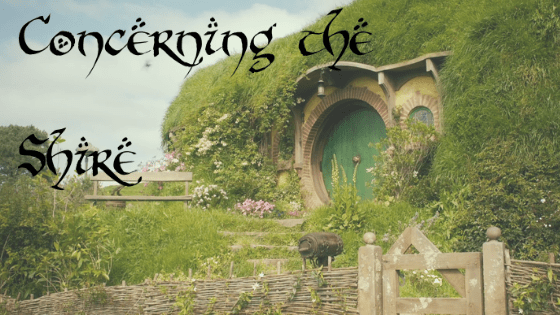
Concerning the Shire

I can’t tell you how many times I’ve read The Lord of the Rings series, or watched the movies, extended editions only, of course. The world of Middle Earth has a way of drawing me in, and I love any minute I can spend there (Sometimes I even watch the movies with commentary from the actors, I know, super nerdy of me, but would totally recommend). While there are so many conversations to be had and themes to explore within the series, one question for me comes to mind every time I enter into the world: Why hobbits from the Shire? Why are halflings, unnoticed by so many, the beginning, center, and end of this epic tale?

Warning: spoilers ahead for all of Lord of the Rings. To be fair, you’ve had about 65 years to read the books and 20 years to watch the movies.


            If you’ve watched the Lord of the Rings, specifically the last of the trilogy The Return of the King, you know that there are about a dozen endings. (At least, it feels that way when you’ve sat through a 12-hour marathon and need to get to the credits for a bathroom break.) Once the eagles rescue Frodo and Sam from the fires of a collapsing Mount Doom, then the Fellowship has to be reunited at Rivendell, Aragon has to be crowned king, the Fellowship parts again as the hobbits head back to the Shire, they enjoy a pint together, and Sam gets married. STILL not the end: Frodo decides to take the last boat leaving the Grey Havens with Gandalf, Bilbo, and the elves, and THEN Sam finally comes home to his family. Only after all of that does the “Into the West” song play and the names role.

            But there’s one ending that Peter Jackson for whatever reason decided not to include in the movie: a chapter in the book titled “The Scouring of the Shire.” In this chapter, the four hobbits come back to the home they’ve fought for, the home they’ve longed to see since leaving more than a year ago, but it is much changed. Gandalf has already separated from them to see Tom Bombadil (a character also notably absent from the film), saying that it is time for the hobbits to fight again for their own home, that this is what they’ve trained for. On coming to the Shire, they find themselves blocked by a gate, a barrier that has never been a part of Shire-life. Unsurprisingly, they easily overtake the hobbits guarding the gate, who keep mentioning “the Chief” living at Bag End, and our beloved heroes make their way to Bag End to take on the Chief and liberate the Shire from his rule. However, the Chief is not Lotho Baggins as they assumed, but Saruman, disguised as Sharkey! It turns out he and Wormtongue escaped from Orthanc tower using his last weapon, his voice, and took control of the last free part of Middle Earth. It is up to the four hobbits to rid the Shire of this bully and free all hobbits from his power-hungry influence.

            I’ve never liked this part of the book. By the time they finally get back to the Shire, I am reveling from the last epic battle at the Black Gate and wiping away tears at the “Many Partings” of dear friends, and this fight for the Shire seems… tacked on? Slightly ridiculous to picture hobbits, who are farmers, picking up their pitchforks at the sound of Merry’s horn? Wouldn’t it have been more suitable and fitting to end with the hero’s commendation given to the hobbits, and a goodbye at the Grey Havens?

But maybe that is really the point of the whole story. The biggest, most evil enemy of the time is defeated by the choices of the smallest, most unassuming creature. One small phial of starlight is enough to overcome the shadow of darkness that lays over the land. The little things, the overlooked things, matter. This little corner of peaceful life consumed only with hearty food, full pints, and a good smoke is worth protecting. As exciting as it is to fight in the grand battles, walk with the noble elves, and feast in the halls of kings, I think Tolkien always meant to point us back to the goodness of simplicity, exemplified by the Shire-folk. Hobbits are small in stature, but not in honor. Notice too that the best of hobbits are not small-minded; all four of our heroes answered the call to adventure when it came knocking at their door and bravely played their part in a larger narrative. In the same way, the Shire and the centrality of the hobbits teaches us to tend our corner of the earth, but to also be ready to fight for the light and play a role in the bigger world beyond our little home when the time comes.

           I think I’m also sad to see the Shire corrupted. Hobbits never harm each other, and yet here in this scouring, hobbits kill each other. Saruman has already destroys much of Fangorn, and now the trees of the Shire are all cut down for his industry. I suppose it breaks my heart to see this scene through the eyes of the hobbits. Throughout the whole story, the Shire is a haven. I fell in love with the Shire from the very beginning of “Concerning Hobbits,” and my love for it only grows the farther the hobbits get from it. Merry and Pippin talk often of their home, telling stories of the simple life of the Shire to kings, elves, and the Ents, most of whom have never even heard of hobbits or their home. Even in the darkest parts of Mordor when Sam is at his weariest, the thought of summertime in the Shire gives him the strength to carry on. It was meant to be a preserved garden, always fruitful and always safe from the arm of the enemy now that the Ring has been destroyed, and yet, it too became corrupted and twisted to the evil will of the enemy. 

            Of course, the story ends on a hopeful note for the Shire, , as Saruman is finally defeated and fades away into nothingness. The hobbits help rebuild the Shire, starting with Sam planting a new tree from the soil of Lothlorien. The Shire becomes safe for future generations, but those who fought for it don’t get to see a full restoration. Their sacrifice isn’t truly rewarded, especially for Frodo. And so we understand why Frodo, still feeling the ache of his wound and the weight of the ring, leaves Middle Earth.

“I tried to save the Shire, and it has been saved, but not for me. It must be so, Sam, when things are in danger: some one has to give them up, lose them, so that others may keep them.”

Frodo, “The Grey Havens”

Even the best of endings come with sorrow, wounds that leave scars, memories too painful to dwell on. We mourn what we lost along the way, but we are better for the journey and stronger for the fight. And that is why hobbits.

            There is so much more to be said on the subject, but as I do not possess Tolkien’s gift of making worlds with only words, I’ll let him finish out my thoughts with Bilbo’s poem:

The Road goes ever on and on 
Out from the door where it began.
Now far ahead the Road has gone,
Let others follow it who can!
Let them a journey new begin,
But I at last with weary feet
Will turn towards the lighted inn,
My evening-rest and sleep to meet.

A Short Thought from an Evening Walk

Recently, some friends (and C.S. Lewis) inspired me to explore nature as a professor. A professor explores with the humble heart of an observer, watching and listening as creation unfolds itself. He seeks to learn and enjoy, as opposed to a magician who seeks to control and derive profit that should not be his to gain. The heart and mind of a professor are aligned in simple adoration and hope to instruct others in this way of experiencing nature and God. (See The Magician’s Nephew if you’re confused)

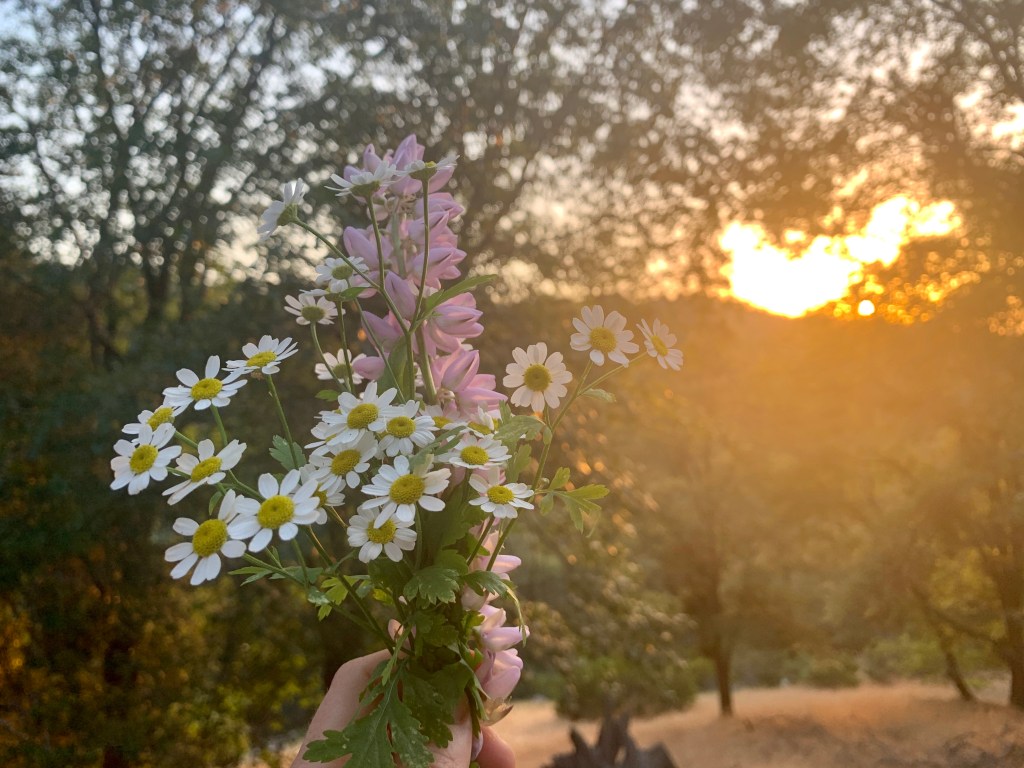
            So tonight, in the midst of my anxious thoughts about life and the numerous disappointments of the current times, I strapped on my Colorado flag Chacos. I walked down a path I’ve never taken before, I picked wildflowers, and I chased the sunset.

            At the beginning of the walk, my mind was still plagued with questions and worries. What do I do next, God? Would you have me stay where I am or look elsewhere? How do I find purpose when I can’t do the job I came here to do? So many demands for clarity and direction. As I walked though, I noticed. My inward focus was pulled outward, and slowly, contentment and peace trickled into my troubled heart.

            My soul is quiet and still now, not because I achieved a resolution to any of my problems, nor because my questions are now answered, not even because of a platitude of a silver lining. No, stillness came when I stopped to listen to the song of creation. It’s an old song of new life, and as I heard the wind whisper through the leaves, I felt the voice of my God and Creator whisper, “I am here.” My worry became worship, my anxiety became adoration, and joining in the creation’s song was as simple as breathing.

The Monster and the Prophet

“Knowledge is knowing Frankenstein is not the monster. Wisdom is knowing Frankenstein is the monster.”

It is a great irony, and one that I’m sure Mary Shelley would love, that Frankenstein usually brings to mind the monster and not the scientist. I’m going to assume most of us have the same mental image when we hear “Frankenstein:” a giant green man with bolts in his neck, a mad scientist in a lightning storm, maybe a hunchbacked assistant. However, those who were forced to read Frankenstein in high school or have a passing knowledge of the seminal gothic novel know that Frankenstein is actually the name of the scientist who created the “monster,” one who was feared by his own creator to the point that Frankenstein never gave his creation a name.

By not giving the creature a name, calling it only by “Creature,” “monster,” or even “daemon,” Frankenstein dooms the creature to a life of undefined otherness. It is neither man nor beast, and without a name, it does not belong to any family. It will always be on the outside of humanity because its only semblance of a father figure is disgusted by it. In his revulsion at his own sin (attempting to attain godhood by creating life unnaturally), Frankenstein failed in his duty as a creator. Being unnamed may not be the sole reason for the tragic story of the creature, but it contributed to his bestial behavior and gives us cause to pity the creature.

Names are significant. They are powerful enough to simultaneously give agency and claim ownership. And there is one Creator who does give his creation a name.

Throughout the book of Isaiah, the poetic conversation between God and prophet often includes a reminder that “I have called you by name, and you are mine” (see Isaiah 43:1, 45:3, and 62:2 just to point out a few). God “fulfilled his duty,” so to speak, to his creation by naming them with his own name, setting them apart and conferring on them certain blessings and rights that come with his name.

The fact that God names Israel defines and expands their relationship. They do not relate simply as king and nation or subjects, they are also father and child. A father names his child, claiming him as his own and conferring the rights of heir to the child. A name gives the child personhood. In naming Israel, God declares himself as Father to them, and with that declaration comes a promise to raise them up and teach them until the time arrives to take up the inheritance. Much to the chagrin of Israel, God as Father means that he promises to rebuke and correct them (think of the terror that strikes in your heart when a parent calls you by your full name; you don’t need a punishment to tell you just how much trouble you’re in). 

Even beyond the Father/child relationship, naming another is a display of intimacy between a Lover and his Beloved. What is sweeter than the sound of a lover whispering the name of his Beloved in her ear? What is more powerful that the lover shouting his Beloved’s name as he recklessly pursues her? What is more beautiful than the turning of the Beloved toward her lover at the sound of her name? Those are promises too, promises to love unconditionally and serve faithfully.

Names matter, and it matters when Israel is not living as one named by God. In their arrogance, they try to name themselves. In their foolish desire, they take on the name of other worldly nations, forgetting the inheritance waiting for them. Only the faithful keep the name given by God, despite doubt, hardships, persecution, and exile. 

So the question for us becomes: What name do you live by? Does your worldly heart desire to make a name for itself? Search your heart well, because you reject your status as a child of God and coheir with Christ if you reject the name God has given you. (Think of the Creature, who could not make a name for himself and became a monstrous brute, hopeless and unloved). Or does your heart sigh in contentment to hear your name spoken by God, the Creator and Lover of your soul? That kind of intimacy might induce fear, because when he says your name it means he knows all of you, but you can rest easy in the promise that perfect love casts out fear.